
Somewhere around your second or third year in HR, the question changes. It stops being whether a credential would help and becomes which exam to put your name down for, and when. For most people working in US human resources, the first serious candidate is the HRCI Professional in Human Resources, the PHR.
That choice has more branches than it first appears to. You might not be eligible yet. You might be better served by the associate level, or already past the PHR and ready for the senior one. If you work outside the United States, or mostly with California law, HRCI builds a different exam for you. This article takes PHR certification as a decision rather than a syllabus, and walks through each branch with the figures HRCI and the exam catalogue actually publish, so you can book the right paper at the right time.
Table of Contents
- What is the PHR, and what are you really deciding?
- Do you meet the PHR certification requirements?
- Does your experience count as professional level?
- Are you ready for this paper yet?
- Does the PHR paper match the job you do?
- PHR or aPHR: when should you start lower?
- PHR or SPHR: which level describes your work?
- PHR, PHRi or PHRca: where do you practise?
- How to make the call
- Frequently Asked Questions
- Conclusion
What is the PHR, and what are you really deciding?
The PHR is HRCI’s Professional in Human Resources certification, built for HR practitioners who implement programmes and run day-to-day operations under US law. Deciding on it means answering four questions in order: are you eligible, is this the right level, is this the right country or state, and are you ready now.
HRCI describes the credential as proof that you can apply technical and operational HR knowledge in real settings, grounded in US laws and regulations. Two words in that description carry most of the weight. “Operational” separates it from the senior credential, which is about strategy. “US” separates it from the international and California variants.
Getting the order right saves money. Eligibility is a hard gate, so there is no point weighing levels until you know which ones you can apply for. Level comes before location, because HRCI’s variants sit at particular levels. Readiness comes last, because it is the only one of the four you can change in a few weeks.
Do you meet the PHR certification requirements?
PHR eligibility depends on professional-level HR experience combined with education. HRCI accepts three routes: at least one year of professional-level HR experience plus a master’s degree or higher, at least two years plus a bachelor’s degree, or at least four years with no degree requirement. An HR degree is not required for any route.
- Master’s degree or higher: one year of professional-level HR experience
- Bachelor’s degree: two years of professional-level HR experience
- No degree: four years of professional-level HR experience
The routes trade education against time, and the trade is generous at the top. A master’s degree cuts the experience requirement to a quarter of the no-degree route. If you finished a graduate programme while working in HR, you may already qualify without realising it.
HRCI publishes these routes on its official PHR page, alongside the fees and exam format. Read the experience wording carefully, though. The years only count if the role behind them meets HRCI’s definition of professional level, and that condition is the part of the gate people most often misjudge in their own favour.
Does your experience count as professional level?
HRCI counts HR experience as professional level when the role involves independent judgement, specialised HR knowledge with some decision authority, in-depth work such as data analysis, contact with a broad range of people including key personnel, and individual accountability for results. Clerical and assistant roles generally do not qualify.
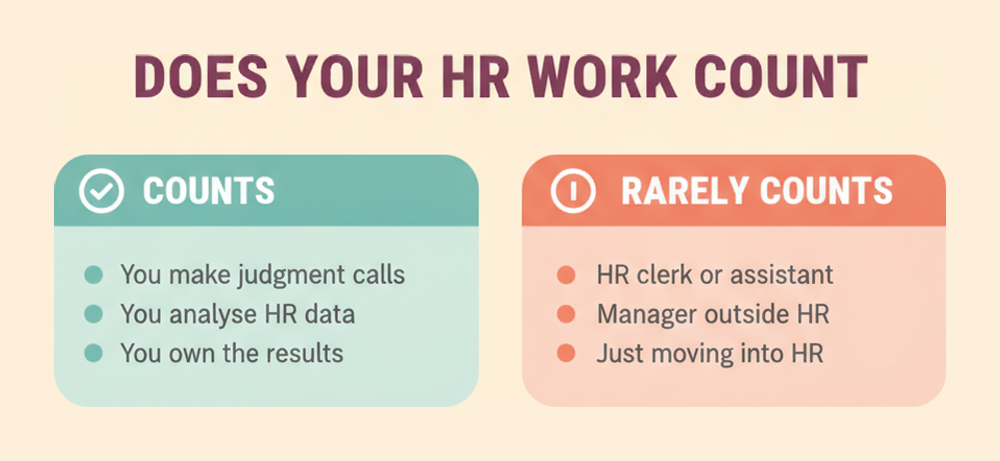
The definition is written as a set of characteristics rather than a list of job titles, so the test is what you actually do. HRCI lists five:
- Using independent judgement and discretion in your work
- Specialised HR knowledge with some authority to make decisions
- In-depth work such as gathering, analysing and interpreting data
- Working with a broad range of people, including key personnel
- Being individually accountable for results
HRCI is just as specific about who is unlikely to qualify. People managers whose main job sits outside HR, entry-level practitioners such as HR clerks and HR assistants, and people transitioning into HR from another profession are all named. A line manager who handles hiring for their own team, however well, is not building PHR eligibility by doing it.
The professional-level definition is worth reading against your own job description before you pay the application fee. If two or three of the five characteristics describe your week, you are likely in scope. If none do, the associate credential is the honest starting point, and HRCI states that this definition does not apply to aPHR candidates at all.
Are you ready for this paper yet?
You are ready for the PHR when you can handle 115 multiple choice questions in two hours and reach a scaled score of 500 on HRCI’s 100 to 700 scale. Only 90 of those questions are scored; the other 25 are unscored pretest items that look identical, so every question has to be treated as live.
| Field | PHR |
|---|---|
| Awarding body | HR Certification Institute (HRCI) |
| Questions | 115 multiple choice (90 scored, 25 pretest) |
| Duration | 120 minutes plus 30 minutes administration time |
| Passing score | 500 on a scaled range of 100 to 700 |
| Exam fee | USD 395 |
| Application fee | USD 100 |
| Delivery | Pearson VUE test centre or OnVUE remote proctoring |
| Validity | Three years, renewed with 60 HR recertification credits or a retake |
Read the scoring correctly
The 500 is not a percentage. HRCI converts every raw score onto the same 100 to 700 scale, and a candidate who does not pass receives a score between 100 and 499. The results report guidance also explains that you see your performance by functional area, but the pass decision rests only on the total.
A different figure often gets confused with it. HRCI publishes a PHR pass rate of 72 percent as of 31 December 2025, which is the share of candidates who passed, not the mark you need. It is still useful for a decision: roughly seven in ten candidates get through, so the paper is demanding but not a gamble for someone who meets the eligibility bar honestly.
Test yourself before you pay
Together the two fees come to USD 495, so a quick readiness check before applying is cheap insurance. Working through a set of PHR sample questions shows whether the scenario style feels familiar or foreign. If most questions describe situations you handle at work, you are close. If they describe work you have only read about, give yourself more time on the job first.
Does the PHR paper match the job you do?
The PHR paper matches your job if your week already touches its seven functional areas in roughly its proportions. Employee and labor relations carries 20 percent, employee engagement 17, total rewards 15, business management and talent acquisition 14 each, and learning and development and HR information management 10 each.
| Functional area | Weight | You are well placed if your job already involves |
|---|---|---|
| Employee and Labor Relations | 20% | Complaints, investigations, policy interpretation, safety and union or nonunion relations |
| Employee Engagement | 17% | Surveys, performance reviews, improvement plans and separations |
| Total Rewards | 15% | Compensation, payroll, benefits and pay equity checks |
| Business Management | 14% | HR metrics, risk, compliance audits and organisational culture |
| Workforce Planning and Talent Acquisition | 14% | Sourcing, interviews, offers, background checks and onboarding |
| Learning and Development | 10% | Training programmes, career development and succession data |
| HR Information Management | 10% | HRIS records, reporting and system access and permissions |
Read the table as a self-audit rather than a study plan. A generalist in a mid-sized company usually recognises most rows. A specialist, say a recruiter or a compensation analyst, often recognises two rows deeply and the rest barely, and that gap is the real preparation workload.
The legal layer deserves a separate look, because it is what makes this a US exam. The objectives name federal law repeatedly, including Title VII, the FLSA and OSHA. If you have not worked with the Title VII statute or its day-to-day effect on hiring and discipline, budget time for it whatever your experience.
For the objective-by-objective treatment of each area, the site’s PHR functional area guide covers them one at a time. This article stays with the choice.
PHR or aPHR: when should you start lower?
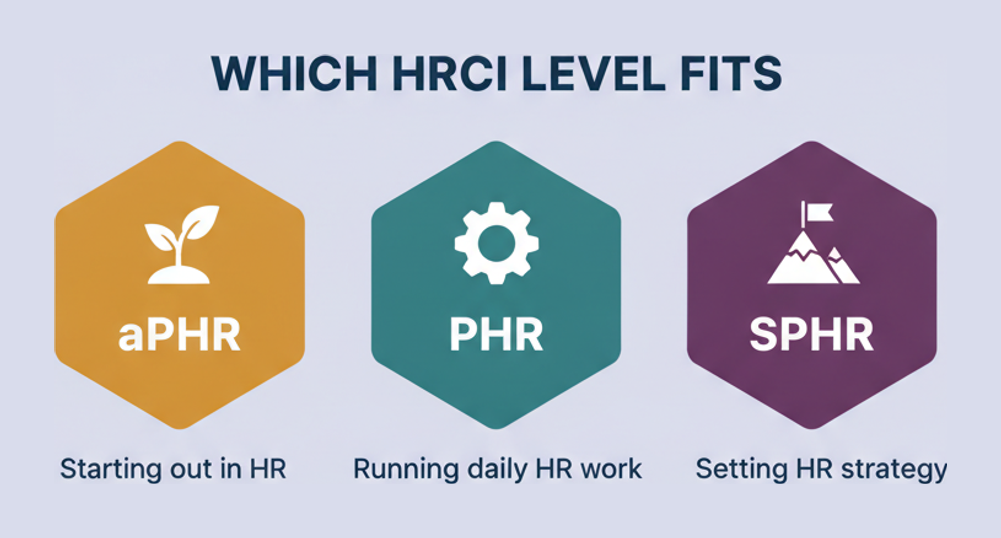
Start with the aPHR if you do not yet meet any PHR eligibility route, or if your HR work is administrative rather than professional level. HRCI requires no HR experience for the aPHR, positions it for people beginning an HR career, and does not apply the professional-level definition to it.
The two credentials test different things. HRCI calls the aPHR a knowledge-based credential, which means it checks that you understand HR fundamentals. The PHR checks that you can apply them in operational situations, which is why it needs experience behind it.
That makes the choice fairly mechanical:
- You are in an HR assistant or coordinator role, or moving into HR from another field: the aPHR fits now.
- You have a qualifying route but only just, and your work is still mostly transactional: the aPHR is a reasonable first step while your role grows.
- You meet a route comfortably and make judgement calls every week: go straight to the PHR.
There is no rule that you must hold the aPHR before the PHR. Skipping it is normal for anyone already eligible. What matters is not sitting a paper built for a job you do not yet do.
PHR or SPHR: which level describes your work?
Choose the PHR if you implement HR programmes and support daily operations, and the SPHR if you shape HR strategy and policy. The SPHR also has a much higher eligibility bar: four years of professional-level experience with a master’s degree, five with a bachelor’s, or seven with neither.
“If the PHR is about mastering operations, the SPHR is about guiding the organization. It signals strategic leadership and advanced HR competency.”
The operations and strategy split is the most useful test available, because it describes your job rather than your seniority. An HR manager who runs recruitment, handles employee relations cases and administers benefits is doing operational work, however senior the title. A head of people who decides workforce policy and advises the executive team on organisational direction is doing the work the SPHR describes.
When the eligibility overlaps
Plenty of people are eligible for both. Someone with a bachelor’s degree and six years of professional HR experience clears the PHR route easily and the SPHR route by a year. The deciding question then is not whether you can apply but which paper describes your working week. Sitting the SPHR on operational experience alone means answering strategy questions you have never had to answer at work.
If you are weighing the senior route seriously, the site’s breakdown of SPHR eligibility routes sets out its gate in detail. The renewal differs too: the SPHR asks for 45 HR and 15 business credits across three years, while the PHR asks for 60 HR credits.
PHR, PHRi or PHRca: where do you practise?
Take the PHR if your HR work is governed by US federal law. HRCI builds the PHRi for practitioners working outside the United States and the PHRca for professionals who support or manage HR in California. HRCI aligns the PHRi to the PHR; what changes between them is the legal ground each exam is built on.
| Credential | Built for | Pass rate to 31 December 2025 |
|---|---|---|
| PHR | Operational HR under US laws and regulations | 72% |
| PHRi | HR practitioners working outside the United States | 84% |
| PHRca | Professionals supporting or managing HR in California | 47% |
The PHR’s federal law content is its defining feature, and it is exactly what makes it a poor fit abroad. An HR generalist in Dubai, Singapore or Frankfurt works under local employment law, often shaped by the international labour standards their country has adopted, and questions about Title VII or the FLSA test nothing they use.
California is a narrower case. HRCI positions the PHRca for professionals who support or manage HR in that one state, so it answers a different question from the PHR rather than a harder version of the same one. If your employer operates in California and elsewhere, the federal paper may still be the broader fit. Whichever you choose, the PHRca’s 47 percent pass rate, the lowest HRCI publishes, is a reason to treat it as a serious exam in its own right.
How to make the call
Make the decision in a fixed order: confirm eligibility, test your experience against HRCI’s professional-level definition, pick the level that matches your work, pick the variant that matches your legal ground, then check readiness with timed questions. Each step removes options, so the last one leaves a single paper to book.
- Check your education and years of HR work against the three PHR routes.
- Test your role against HRCI’s five professional-level characteristics.
- Decide whether your work is mainly operational or mainly strategic.
- Confirm which legal system your HR decisions actually run under.
- Audit your job against the seven functional area weights and note the gaps.
- Time yourself on a sample set before paying the application fee.
If you reach step six and the questions still feel like someone else’s job, that is the answer too. Waiting six months while your role widens costs nothing, and a PHR earned later is still valid for the same three years, so there is no advantage in arriving early and underprepared.
Frequently Asked Questions
What are the PHR certification requirements?
One year of professional-level HR experience with a master’s degree or higher, two years with a bachelor’s degree, or four years without a degree. The experience must meet HRCI’s professional-level definition, and an HR degree is not required.
How many questions are on the PHR exam?
There are 115 multiple choice questions. Ninety are scored and 25 are unscored pretest items that are not identified, so you should answer every question as though it counts.
What score do you need to pass the PHR?
A scaled score of 500 on HRCI’s range of 100 to 700. It is not a percentage, and candidates who do not pass receive a score between 100 and 499.
What is the PHR pass rate?
HRCI reports a PHR pass rate of 72 percent as of 31 December 2025. That is the share of candidates who passed, not the passing score.
How much does the PHR cost?
The exam fee is 395 US dollars and the application fee is 100, so 495 in total for one attempt.
Can I take the PHR without an HR degree?
Yes. HRCI does not require an HR degree for any route. With no degree at all, you need four years of professional-level HR experience.
Should I take the PHR or the SPHR?
Choose by the work you do. The PHR fits HR professionals implementing programmes and running daily operations; the SPHR fits leaders who shape HR strategy and policy and needs four to seven years of experience depending on education.
Is the PHR valid outside the United States?
The credential itself is HRCI’s, but the exam is grounded in US federal law. HRCI offers the PHRi specifically for HR practitioners working outside the United States.
Is the PHR the same as the SHRM-CP?
No. They come from different organisations: the PHR is awarded by HRCI and the SHRM-CP by SHRM. Each has its own eligibility rules, exam and renewal requirements.
Conclusion
PHR certification is the right next move for a US HR practitioner who meets an eligibility route, does genuinely professional-level work, and spends most of the week on operations rather than strategy. For anyone else, HRCI already has a better-fitting paper: the aPHR for those starting out, the SPHR for those setting direction, and the PHRi or PHRca for those whose legal ground is not federal US law.
Make the decision in order, because each step narrows the next. Eligibility first, then level, then location, then readiness. When everything points to the PHR, a timed run through realistic sample questions is the last check before the USD 495 is spent, and the most reliable signal of whether the paper describes your job yet.


