
Under the eligibility criteria sits a footnote, and it is the most consequential line on the page.
It reads that the SPHRi requires documented knowledge of local employment laws. HRCI sets it apart from the three experience routes, in smaller type, and almost no summary of this credential repeats it. Yet it is the condition that decides whether a candidate with the right number of years is actually suited to the Senior Professional in Human Resources, International. The rest of the SPHRi exam requirements are more conventional: four years of professional-level HR experience with a master’s degree, five with a bachelor’s, or seven with neither. The paper itself runs 140 items over 165 minutes plus 30 minutes of administration, costs 495 US dollars on top of a 100 dollar application fee, and devotes a full third of its content to Leadership and Strategy. This guide walks all of it, including the one number almost every other page gets wrong.
What Are the SPHRi Exam Requirements?
Three things: a qualifying combination of professional-level HR experience and education, documented knowledge of local employment laws, and an approved application. HRCI publishes three routes based on years of experience against degree level, and a candidate needs to satisfy only one of them. There is no examination prerequisite and no other credential to hold first.
The credential is designed for HR leaders based outside the United States who set HR strategy and guide organisational direction within a single international setting. That scoping matters. SPHRi is not the global mobility credential and it is not the United States senior credential; it is the senior tier for someone running HR in one country that is not the US.
The application is a separate step from the booking, with its own fee, and approval comes before scheduling. Candidates who want a sense of how the questions land at senior level before starting that process usually work through the SPHRi practice exam first, because senior-tier items read very differently from professional-tier ones.
What is not required
- No PHRi or other HRCI credential is needed beforehand
- No specific training course is mandated
- No degree at all is needed on the seven year route
- No United States experience is expected or relevant
Which of the Three Experience Routes Do You Meet?
HRCI accepts three combinations, and meeting any one of them qualifies you. Four years of experience in a professional-level HR role plus a master’s degree or global equivalent. Five years in a professional-level HR role plus a bachelor’s degree or global equivalent. Or seven years in a professional-level HR role with no degree requirement attached.
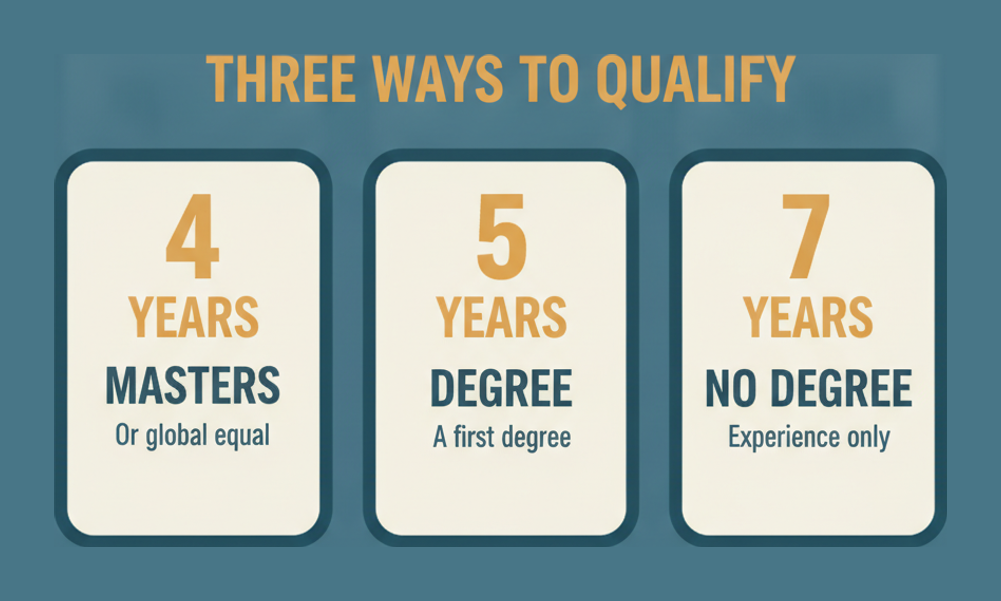
| Route | Professional-level HR experience | Education |
|---|---|---|
| 1 | At least 4 years | Master’s degree or global equivalent |
| 2 | At least 5 years | Bachelor’s degree or global equivalent |
| 3 | At least 7 years | None required |
The phrase doing the work in all three rows is professional-level. HRCI means HR work that involves judgement, autonomy and responsibility for outcomes, not time served in an HR department. Years spent on administration, data entry or transactional support do not count toward the total, however long they ran, and that is where most rejected applications come unstuck.
The global equivalent wording is deliberate and it is generous. HRCI does not require a degree awarded in any particular country, which is the point of an international credential. What it does require is that the qualification is genuinely equivalent in level, and an application will be assessed on that basis rather than on the name of the award. The full criteria sit on HRCI’s SPHRi credential page.
What Does Documented Knowledge of Local Employment Laws Mean?
It means you are expected to know the employment law of the jurisdiction you actually work in, and to be able to evidence that knowledge. HRCI carries this as a condition on the SPHRi eligibility criteria rather than as an exam topic, which is why it is easy to miss and why it changes who the credential suits.
The reason is structural. An international senior credential cannot examine every jurisdiction’s employment law, so HRCI does not try. Instead it examines the strategy, talent and rewards work that is comparable across borders, and it requires that the candidate already brings the legal grounding for their own market. The exam tests the parts that travel; the eligibility condition covers the part that does not.
In practice this rules out one type of candidate more than any other. Someone with strong regional HR operations experience but no exposure to the statutory framework they operate under is not the intended audience, even with seven years behind them. Someone who has handled terminations, working time, collective agreements or data protection obligations in their own country already has what the condition asks for.
If you want a reference point for how widely employment law varies, the International Labour Organization’s international labour standards show which principles are broadly shared and which are left to national law. The ones left to national law are exactly the ones HRCI expects you to know for your own market.
What Are the SPHRi Exam Details?
SPHRi is a 140 item paper delivered in 165 minutes, with a further 30 minutes of administration time on top. Only 115 of those items are scored; the remaining 25 are unscored pretest questions. The exam fee is 495 US dollars and the application fee is a separate 100 dollars, giving a total of 595.
| Field | Value |
|---|---|
| Credential | HRCI Senior Professional in Human Resources, International |
| Exam code | SPHRi |
| Total items | 140 |
| Scored items | 115 |
| Pretest items | 25, unscored |
| Exam time | 165 minutes, plus 30 minutes administration |
| Exam fee | USD 495 |
| Application fee | USD 100 |
| Format | Mostly multiple choice |
| Delivery | Pearson VUE test centre, with online proctoring available |
The 25 pretest items are worth understanding rather than worrying about. They are questions HRCI is trialling for future papers, they are mixed in with the scored items and they are not identified, so there is no way to spot one and no benefit in trying. They exist because a credential that reuses the same bank indefinitely stops discriminating between candidates.
Timing is comfortable by the standards of senior HR exams. One hundred and sixty five minutes across 140 items is a little over 70 seconds each, and a meaningful share of those items are recognition questions that take far less. The scenario items at the senior tier absorb the difference.
Why There Is No 76 Percent Pass Mark
Because HRCI does not publish a percentage passing score for any of its exams. It reports results as a scaled score on a range from 100 to 700, with the pass mark set at 500 for every credential in the portfolio. A candidate who does not pass sees a number between 100 and 499, and the closer it sits to 500 the closer they came.
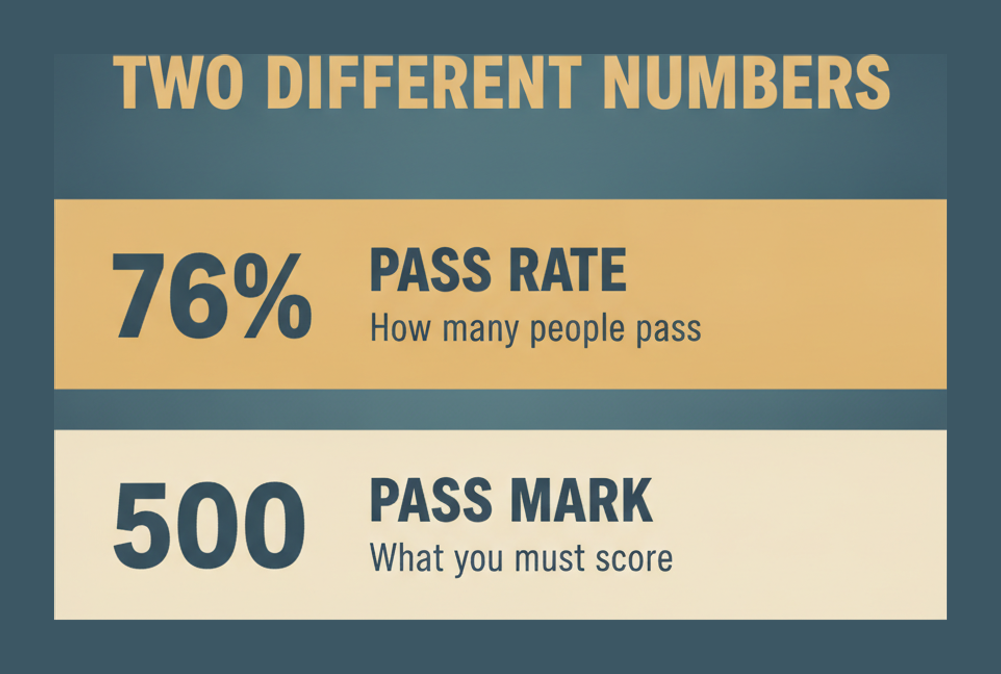
The 76 percent figure that circulates for SPHRi is real, but it is a different statistic entirely. It is the proportion of SPHRi candidates who passed, published by HRCI alongside the pass rates for its other credentials because accreditation standards require annual disclosure. Confusing the two turns a fact about the cohort into a fact about the exam, and they are not the same thing at all.
Scaled scoring exists so that different forms of the same exam remain comparable. Item difficulty varies between versions, and a raw percentage would mean different things on an easier form and a harder one. Transforming every form onto the same 100 to 700 scale removes that variation, which is why HRCI states plainly on its results report guidance that pass decisions rest on the total scaled score.
What this changes for you
Two things. First, stop targeting a percentage in practice, because there is no percentage to target; aim instead for consistent performance across all five functional areas. Second, treat the published pass rate as context rather than as a bar. For the record, HRCI’s published pass rates put SPHRi at 76 percent as of 31 December 2025, among the higher rates in its portfolio.
One more detail from the results report matters for planning. HRCI reports your performance per functional area, but the pass decision is made on the total. A weak area does not fail you on its own, so the efficient strategy is to lift your weakest two rather than to perfect your strongest.
Why Is a Third of the Exam Leadership and Strategy?
Because that is what separates the senior tier from the professional one. Leadership and Strategy carries 33 percent of SPHRi, the largest functional area by a wide margin, covering leading the HR function, developing HR strategy, contributing to organisational strategy, influencing people management practice and monitoring risk.
The responsibilities inside it are unmistakably executive. Contributing to organisational vision, mission and values. Developing and leading HR strategies aligned to the strategic plan, with budgets and service delivery plans attached. Analysing internal and external factors to choose a risk management strategy, including business continuity and geopolitical scanning. Interpreting business metrics, key performance indicators, financial statements and budgets to drive strategic goals.
It also reaches into areas that a professional-tier credential touches only lightly: shaping organisational culture through workplace practice, sustainability and corporate social responsibility, promoting inclusivity initiatives, identifying HR metrics such as predictive analytics and pay equity analysis, and designing change strategies to align organisational performance.
The practical reading is that a third of your preparation belongs here, and that experience is worth more than study in this area than anywhere else on the paper. Candidates who have actually argued a workforce plan against a budget find these items straightforward. Candidates who have only read about it find them slippery, because several options are usually defensible and the exam wants the one that follows from the strategy.
How Do the Other Four Functional Areas Divide?
Talent Management takes 23 percent, Workforce Planning and Talent Acquisition and Total Rewards take 17 percent each, and HR Information Management, Safety, and Security takes 10 percent. Together they account for 67 percent of the exam, with Leadership and Strategy holding the remaining third.
| Functional area | Weight | Scored items, roughly |
|---|---|---|
| Leadership and Strategy | 33% | 38 |
| Talent Management | 23% | 26 |
| Workforce Planning and Talent Acquisition | 17% | 20 |
| Total Rewards | 17% | 20 |
| HR Information Management, Safety, and Security | 10% | 11 |
Talent Management at 23 percent is the second pillar and the one most people underestimate at senior level, because it moves past recruitment mechanics into development, succession and performance systems. Workforce Planning and Talent Acquisition covers the supply side, and Total Rewards covers compensation and benefits structures rather than payroll operation.
The smallest area is the one to handle last. HR Information Management, Safety, and Security at 10 percent is roughly eleven scored items, and while data protection obligations make it more consequential than the weighting suggests, it does not justify the time the two largest areas demand.
If you are still weighing SPHRi against the professional tier, the weighting pattern is the clearest signal of the difference. Our guide to the PHRi credential covers the tier below, where the balance sits much further toward operational delivery than toward strategy.
How Should You Prepare for the SPHRi Exam?
By confirming eligibility first and then studying in proportion to the weightings. A third of the paper is strategy, so a third of the preparation belongs there, and the smallest area deserves an afternoon rather than a week. The application approval step also sits before scheduling, so it belongs at the start of the plan rather than the end.
- Test yourself against the three experience routes before anything else, counting only professional-level HR work in which you exercised judgement and owned outcomes rather than every year spent in an HR department.
- Check honestly whether you can evidence knowledge of the employment law in your own jurisdiction, because that condition sits alongside the experience requirement rather than being satisfied by it.
- Submit the application and wait for approval before booking anything, since the 100 dollar application fee and the 495 dollar exam fee are separate steps and the second depends on the first.
- Give Leadership and Strategy a third of your study time to match its 33 percent weighting, working from your own experience of strategy, budgets and risk rather than from definitions.
- Move to Talent Management next at 23 percent, treating development, succession and performance systems as the senior-tier subjects they are rather than as recruitment follow-on.
- Cover Workforce Planning and Total Rewards together, since both are 17 percent and both concern the supply and the price of people, which makes them efficient to study as a pair.
- Finish with HR Information Management, Safety, and Security in a single session, giving the smallest area at 10 percent the time its weighting justifies and no more.
Aim for consistency rather than a target percentage while you practise. Since the pass decision rests on a total scaled score, lifting your two weakest areas moves you further than perfecting your strongest, and the per-area feedback on the results report is designed for exactly that diagnosis. Anyone still deciding whether the credential earns its cost will find the case set out in our companion piece on SPHRi career value, which covers the salary and role questions this guide deliberately leaves alone.
Frequently Asked Questions
What are the SPHRi eligibility requirements?
One of three routes: four years of professional-level HR experience with a master’s degree, five years with a bachelor’s degree, or seven years with no degree. All three also require documented knowledge of local employment laws.
What is the SPHRi passing score?
HRCI publishes no percentage. Results are reported as a scaled score between 100 and 700, and the passing score is set at 500 for every HRCI exam rather than as a share of questions answered correctly.
Is the SPHRi pass mark 76 percent?
No. Seventy six percent is HRCI’s published SPHRi pass rate as of 31 December 2025, meaning the share of candidates who passed. It is a statistic about the cohort, not the bar you have to clear.
How much does the SPHRi exam cost?
The exam fee is 495 US dollars and the application fee is a separate 100 dollars, so the total is 595. Once an application is approved, the fee is not refundable if you withdraw.
How many questions are on the SPHRi exam?
One hundred and forty items in total, of which 115 are scored and 25 are unscored pretest questions. The pretest items are not identified during the exam and cannot be spotted.
How long is the SPHRi exam?
One hundred and sixty five minutes of exam time, with a further 30 minutes of administration time on top. That works out at a little over 70 seconds for each of the 140 items.
Which functional area carries the most weight?
Leadership and Strategy at 33 percent, a full third of the exam. Talent Management follows at 23 percent, then Workforce Planning and Total Rewards at 17 percent each, and information management, safety and security at 10.
Do I need PHRi before taking SPHRi?
No. There is no credential prerequisite for SPHRi and no required training course. Eligibility rests entirely on the experience and education routes plus the employment law condition.
Can I take the SPHRi exam online?
Yes. HRCI offers online proctoring alongside delivery at a Pearson VUE test centre, so the exam can be sat remotely where that option is available in your region.
Conclusion
The SPHRi exam requirements come down to one of three experience routes, a documented grasp of the employment law where you work, and an approved application before you can book. The paper itself is 140 items over 165 minutes, 115 of them scored, for 495 US dollars plus a 100 dollar application fee, and a third of it is Leadership and Strategy. Scoring is a scaled 100 to 700 with 500 to pass, which means the 76 percent so often quoted as a pass mark is actually the share of candidates who pass.
Preparation that follows the weightings rather than the syllabus order is what works here, with strategy taking the largest share and the information management area taking a single session. Once your own experience lines up against the functional areas, a run through a full practice set is the quickest way to see which two areas still owe you time.


