
A common assumption about the PHRi certification is that it is the PHR with a different sticker on it, sat by people who happen to work abroad. It is not. HRCI built the Professional in Human Resources – International around a different premise: that the practitioner knows their own jurisdiction’s employment law and is being tested on whether they can apply globally recognised HR principles inside it.
That premise changes what the exam asks. It does not test the American statutory framework, so questions turn on judgement rather than on which act applies. And it explains the weighting: Employee and Labor Relations carries 20 percent, the heaviest of seven functional areas, because relations work is where local law and universal principle collide most often. This guide covers the three eligibility routes, all seven weighted areas, the exam mechanics, and one detail almost every other page gets wrong: how HRCI actually scores the paper. The global tier above it works the same way, and the GPHR scored item split shows how many items actually count.
What Is the PHRi Certification For?
The PHRi certification validates professional-level HR competency for practitioners working outside the United States. HRCI designed it around globally recognised HR principles applied within a candidate’s own local context, rather than around any single country’s employment legislation. It sits at the professional tier of HRCI’s international track, above the associate-level aPHRi and below the senior SPHRi.
The distinction that matters is what the exam holds constant. A US credential can assume a shared statutory baseline and test whether you know it. An international credential cannot, so it tests the reasoning instead: what a competent HR professional does when faced with a hiring decision, a grievance or a pay structure, with the local rules taken as given.
In practice that suits a specific reader. Someone running HR for a regional office, a multinational’s local entity, or a company with no US footprint at all, who wants an independent read on their capability that a hiring manager anywhere will recognise. HRCI’s own PHRi credential page is explicit that this is the audience.
Who Is Eligible for the PHRi Exam?
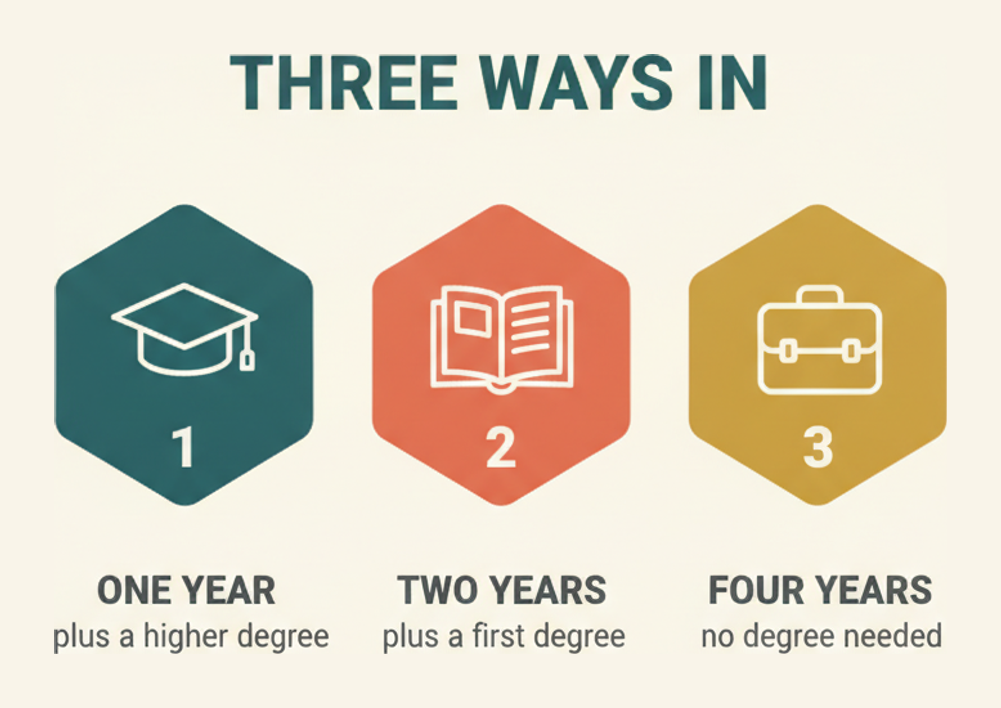
PHRi eligibility runs through three alternative routes, and a candidate needs to satisfy only one. Either one year of professional-level HR experience plus a master’s degree or global equivalent; or two years plus a bachelor’s degree or global equivalent; or four years of professional-level HR experience with no degree requirement at all. The senior tier is stricter, and the SPHRi experience requirements are worth reading before you choose a level.
| Route | HR experience | Qualification |
|---|---|---|
| One | 1 year, professional level | Master’s degree or global equivalent |
| Two | 2 years, professional level | Bachelor’s degree or global equivalent |
| Three | 4 years, professional level | None required |
Two things in that structure are worth reading carefully. The phrase global equivalent does real work: HRCI is not asking for a degree from a particular system, which is the point of an international credential. And the third route removes the qualification requirement entirely in exchange for two more years of practice, which keeps the door open for people who came into HR sideways.
The recurring phrase is professional level, and it is the part candidates most often misjudge. Administrative HR work, however competent, is not what HRCI means. The distinction is between carrying out HR processes and exercising judgement over them.
What Are the PHRi Exam Details?
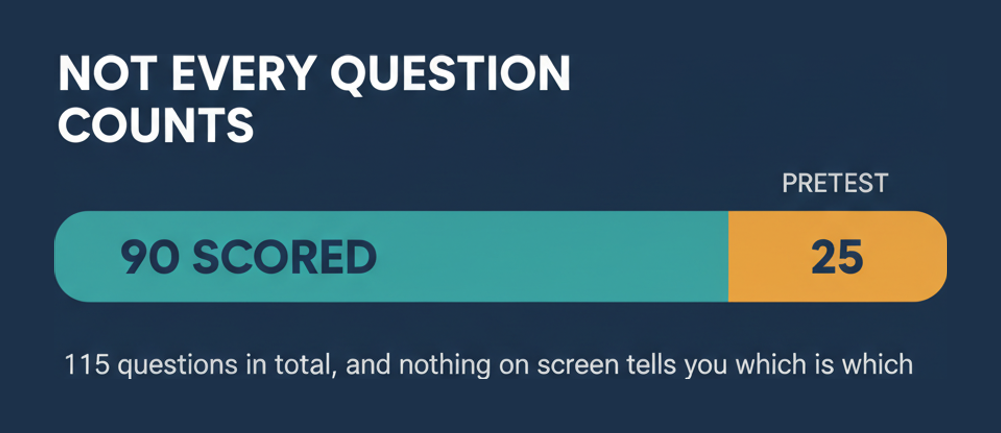
The PHRi exam carries 115 questions and runs 135 minutes plus 30 minutes of administration time. It costs 395 US dollars for the exam, plus a separate 100 dollar application fee, and is delivered through Pearson VUE, at a test centre or online. Of the 115 items, 90 are scored and 25 are unscored pretest questions.
| Field | Value |
|---|---|
| Exam name | HRCI Professional in Human Resources – International |
| Exam code | PHRi |
| Questions | 115 total, of which 90 are scored |
| Duration | 135 minutes, plus 30 minutes administration time |
| Exam fee | $395 |
| Application fee | $100 |
| Format | Mostly multiple choice |
| Delivery | Pearson VUE test centre, or online through OnVUE remote proctoring |
The pretest questions are the detail worth internalising. Twenty five of the items you answer do not count towards your result at all, and nothing on screen tells you which. HRCI uses them to trial wording for future forms. The practical consequence is that an item which feels unreasonably obscure may simply not be part of your score, and dwelling on it costs time that scored questions need.
On pace, 135 minutes across 115 items works out at just over 70 seconds each, which is comfortable for a paper that is mostly multiple choice. The 30 minutes of administration time is separate and covers check in and the tutorial, not answering. Sitting PHRi practice questions to that timing is the simplest way to confirm the pace is genuinely comfortable for you.
How Is the PHRi Exam Actually Scored?
HRCI reports PHRi results as a scaled score on a range of 100 to 700, with the passing score set at 500. It does not publish a percentage. Pass or did not pass is decided on the total scaled score for the whole exam, not area by area, and a scaled score is a transformation of the raw count of correct answers rather than the count itself.
This is the single most misreported fact about the credential. Percentage figures circulate widely, including on otherwise careful pages, and they do not come from HRCI. The organisation’s own results report guidance sets the scale out plainly and applies the same transformation to every HRCI exam so that all of them sit on one scale.
Why scaling exists
Exams are assembled from item banks, and no two forms are identical in difficulty. Scaling absorbs that variation so a candidate who sits a marginally harder form is not penalised for it. The consequence is that no fixed number of correct answers guarantees a pass, and any target expressed as a percentage of questions is a guess.
What the results report gives you
Alongside the overall result, HRCI breaks performance down by functional area, showing where you were strong and where you were not. For a candidate who did not pass, that turns a retake into a targeted exercise rather than a repeat of the whole syllabus. A did-not-pass score between 100 and 499 also tells you how close you were: the nearer to 500, the smaller the gap.
Why Does Employee and Labor Relations Carry 20 Percent?
Employee and Labor Relations is the heaviest PHRi functional area at 20 percent, ahead of Employee Engagement at 17 percent and Total Rewards at 15 percent. Roughly one question in five comes from it. It covers the day to day management of the employment relationship, from grievances and discipline through to collective representation.
The weighting reflects where an international credential is genuinely tested. Recruitment practice, pay design and learning programmes travel across borders reasonably well. Employee relations does not. Notice periods, dismissal procedure, works councils, collective bargaining and consultation obligations differ sharply between jurisdictions, and getting them wrong is expensive in a way that a badly designed training plan is not.
What the exam does with that is instructive. It cannot test the specific law of your country, so it tests the principles that sit underneath the rules and the judgement calls that survive translation. Familiarity with the way international labour standards frame these obligations is genuinely useful preparation here, not because the exam quotes them, but because they are the shared vocabulary most national frameworks were built against.
For revision this has one clear implication. If your practical experience is concentrated in recruitment or reward, the relations questions are where you will feel it, and they carry the most marks.
PHRi or PHR: Which One Applies to You?
The choice is decided by where you practise rather than by preference. HRCI designed the PHR around United States employment law and the PHRi for practitioners working outside it. Someone running HR in Dubai, Nairobi or Kuala Lumpur takes the PHRi; someone running HR in Chicago takes the PHR.
Where the question becomes real is for people in mixed situations: a regional HR lead covering several countries including a US entity, or a professional planning to relocate. The useful test is which body of law you actually apply. If US statute is the framework you work inside daily, the PHR tests something you use. If it is not, studying it is effort spent on a jurisdiction you do not operate in.
The credentials sit at the same professional tier and neither is treated as the senior version of the other. HRCI runs parallel tracks: aPHRi, PHRi and SPHRi internationally against aPHR, PHR and SPHR in the United States. Progression happens within a track rather than across it. If you are weighing the whole ladder rather than one rung, the HRCI certification hub lays the tiers out together.
What Do the Seven Functional Areas Cover?
The PHRi exam is organised into seven weighted functional areas that together account for 100 percent of the paper. Employee and Labor Relations is heaviest at 20 percent, followed by Employee Engagement at 17 percent and Total Rewards at 15 percent. Business Management and Workforce Planning and Talent Acquisition sit at 14 percent each, with Learning and Development and HR Information Management at 10 percent apiece.
| Functional area | Weight | What it covers |
|---|---|---|
| Employee and Labor Relations | 20% | Managing the employment relationship, grievance and discipline, collective representation |
| Employee Engagement | 17% | Retention, culture, performance and the practices that keep people committed |
| Total Rewards | 15% | Pay structures, benefits and the whole package used to attract and hold talent |
| Business Management | 14% | Reading the organisation and its environment, cross-functional stakeholders, risk, metrics, culture and ethics |
| Workforce Planning and Talent Acquisition | 14% | Local hiring law, sourcing methods, and the talent acquisition lifecycle through to onboarding |
| Learning and Development | 10% | Building capability, training design and delivery, and measuring whether it worked |
| HR Information Management | 10% | HR data, systems and records, and the reporting the rest of the function depends on |
Read as a set, the weightings say something about how HRCI sees the professional-level role. The three areas concerned with the ongoing relationship between employer and employee, relations, engagement and rewards, come to 52 percent of the paper between them. The two administrative and enabling areas come to 20 percent. This is a credential about managing people rather than running processes, which is broadly how human resource management as a discipline has evolved.
How Should You Prepare for the PHRi Exam?
Preparation works best weighted by functional area rather than spread evenly, because the seven areas range from 20 percent down to 10 percent and no area is optional. Start by mapping your own practical experience onto the seven, which usually reveals two or three you have barely touched, then let the weightings decide how the remaining time is split.
- Confirm which of the three eligibility routes applies to you and gather the evidence for it, since the application is separate from the exam fee and comes first.
- Map your own working experience onto the seven functional areas and mark the ones where you have done little or nothing in practice.
- Start with Employee and Labor Relations, the heaviest area at 20 percent, and work the principles behind grievance, discipline and collective representation rather than the statute of any one country.
- Move to Employee Engagement at 17 percent and Total Rewards at 15 percent, which together with relations account for just over half the paper.
- Cover Business Management and Workforce Planning and Talent Acquisition at 14 percent each, paying attention to the metrics and risk material in the first and the hiring lifecycle in the second.
- Finish with Learning and Development and HR Information Management at 10 percent apiece, which are the lightest areas but still worth a fifth of the paper between them.
- Sit full length timed practice at 115 questions in 135 minutes, and practise moving on quickly from any item that feels obscure, since more than a fifth of the paper is unscored pretest material.
The HRMExam PHRi exam resources page collects the practice material for that final timed step.
What Keeping the Credential Involves
PHRi is valid for three years. Maintaining it means earning 60 HR recertification credits across that period, or retaking the exam. The credits are the intended route, and they come from professional development activity rather than from a single renewal transaction.
Three years is a shorter cycle than some credentials run, and the 60 credit requirement works out at 20 a year. For someone already attending conferences, running projects and taking training as part of their job, that is largely a documentation exercise. For someone in a small HR function with no training budget, it is a genuine commitment worth pricing in before starting.
The retake option exists but is rarely the cheaper path once the exam fee is counted. The more useful way to see the credit requirement is as the thing that keeps the credential meaningful: HR practice moves, and a certificate awarded once and never revisited says progressively less about current capability.
Frequently Asked Questions
What is the passing score for the PHRi exam?
HRCI reports a scaled score between 100 and 700 with the pass mark set at 500. It does not publish a percentage, and pass decisions are made on the total scaled score for the whole exam.
How many questions are on the PHRi exam?
115 in total, of which 90 are scored and 25 are unscored pretest items. Nothing on screen identifies which is which, so every question has to be treated the same way.
How long is the PHRi exam?
135 minutes of testing time, with a further 30 minutes of administration time for check in and the tutorial. That is just over 70 seconds per question for the answering portion.
What does the PHRi cost?
395 US dollars for the exam plus a separate 100 dollar application fee, so 495 in total before any preparation material. The application is submitted and assessed before you can book.
Am I eligible for the PHRi?
You need one of three routes: one year of professional-level HR experience with a master’s degree or global equivalent, two years with a bachelor’s or equivalent, or four years of experience with no degree requirement.
Which functional area carries the most marks?
Employee and Labor Relations at 20 percent, roughly one question in five. Employee Engagement follows at 17 percent and Total Rewards at 15 percent.
Is the PHRi harder than the PHR?
Neither is positioned above the other. They sit at the same professional tier on parallel tracks, one built around United States employment law and one for practice outside it, so the choice follows where you work.
How long does PHRi certification last?
Three years. Keeping it means earning 60 HR recertification credits within that period, which works out at 20 a year, or sitting the exam again.
Where is the PHRi exam delivered?
Through Pearson VUE, either at a test centre or online with OnVUE remote proctoring. The application to HRCI is assessed first, and booking follows approval rather than running alongside it.
Does the PHRi test United States employment law?
No. HRCI built it for practitioners working outside the United States, so it tests globally recognised HR principles applied within your own local legal context rather than a specific national statute.
Conclusion
PHRi rewards a particular kind of competence: knowing what good HR practice looks like when the rulebook is your own and nobody has written the answer down for you. The weightings say so directly, with more than half the paper given over to relations, engagement and rewards.
Two facts should shape how you approach it. The pass mark is a scaled 500 out of 700, not a percentage, so no target expressed as a proportion of correct answers is meaningful. And 25 of the 115 questions do not count, which makes pace and composure worth as much as recall. Map your experience against the seven functional areas, put the time where the weightings are, then rehearse the full 115 items under timing before you book.


