
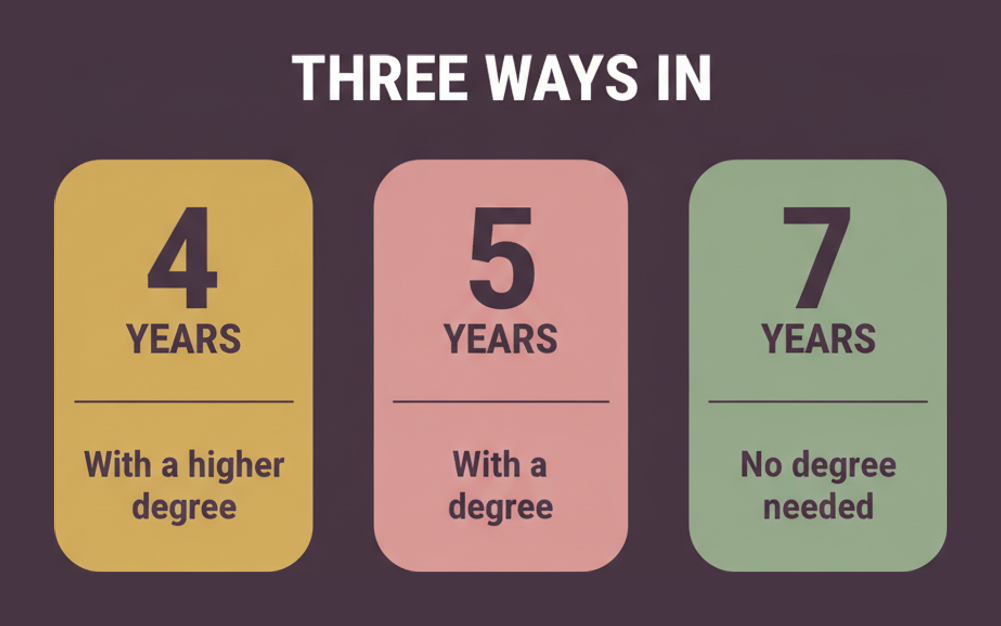
Before the SPHR exam is difficult, it is closed. HRCI checks your experience against three eligibility routes at application, and a candidate who does not clear one of them cannot buy a sitting at all. Four years of professional-level HR experience with a master’s degree or higher. Five years with a bachelor’s. Seven years without a degree requirement. That gate is the first thing worth reading, and most guides skip past it to the syllabus.
Clear it, and the exam behind it is a strategic paper rather than an operational one. The Senior Professional in Human Resources credential puts a third of its weight on Leadership and Strategy alone, runs 140 items in 150 minutes with the pass set at a scaled 500 on a 100 to 700 range, and costs $495 on top of a $100 application fee. This guide sets out the SPHR certification requirements in full, then what the five functional areas actually ask once you are through the door.
What Are the SPHR Certification Requirements?
HRCI publishes three eligibility routes, and a candidate needs to satisfy exactly one of them. Four years of professional-level HR experience plus a master’s degree or higher. Five years plus a bachelor’s degree. Or seven years of professional-level HR experience, where the years replace the qualification. There is no route with fewer than four years. Practitioners based outside the United States should compare these against the SPHRi certification requirements.
| Route | Professional-level HR experience | Education |
|---|---|---|
| One | At least 4 years | Master’s degree or higher |
| Two | At least 5 years | Bachelor’s degree |
| Three | At least 7 years | No degree requirement stated |
The load-bearing phrase in all three is professional-level. HRCI is not counting years spent in HR administration or coordination; it is counting years spent making decisions of the kind the exam tests. That distinction is what trips up candidates who have been in an HR function for a decade in support roles and assume the seven-year route is automatic. Candidates who fall short of those years often find that choosing the PHR instead is the better first step.
Why Does Eligibility Come Before Everything Else?
Because it is checked before you can book, and because the $100 application fee is separate from the $495 exam fee. Application comes first, eligibility is assessed against it, and only then does the exam become purchasable. Getting the order wrong is the most common avoidable cost in this credential.
The second reason is that eligibility describes the exam. HRCI does not require four to seven years arbitrarily; it requires them because the questions assume you have already sat in the meetings they describe. A senior paper that asks you to advise on human capital risk, evaluate the applicability of federal law to a business expansion, or design a total rewards philosophy for executives and board members is not testable by someone who has read about those things.
So the honest first step is an audit rather than a study plan. Count the years that were genuinely professional-level, match them against the three routes, and only then decide whether this is the credential for now or for two years’ time. The full current terms sit on HRCI’s own SPHR certification page.
How Is the SPHR Exam Weighted?
Leadership and Strategy takes 33 percent, Talent Management 23 percent, Workforce Planning and Talent Acquisition and Total Rewards 17 percent each, and HR Information Management, Safety, and Security closes at 10 percent. Applied to 140 items that is roughly 46 questions on strategy alone.
| Functional area | Weight | Approximate items of 140 |
|---|---|---|
| Leadership and Strategy | 33% | 46 |
| Talent Management | 23% | 32 |
| Workforce Planning and Talent Acquisition | 17% | 24 |
| Total Rewards | 17% | 24 |
| HR Information Management, Safety, and Security | 10% | 14 |
The shape of that table is the whole argument for the credential. Strategy and talent management together account for 56 percent, while the systems-and-safety area, which is where a lot of operational HR work actually happens, is worth 14 items. Candidates who are strongest in HRIS administration find the paper unbalanced against them, and rehearsing against SPHR practice questions area by area is the quickest way to see whether that describes you.
Why Is Leadership and Strategy a Third of the Paper?
Because the credential is designed to certify the HR leader rather than the HR practitioner. The area covers leading the HR function itself: developing HR strategy, contributing to organisational strategy, influencing people management practices and monitoring risk. Forty-six items is more than the next two areas combined.
What sits inside it
The responsibilities range wider than the title suggests. They include contributing to vision, mission, values and ethical conduct; aligning HR strategy to the organisational plan through initiatives, budgets and workforce requirements; analysing internal and external factors to choose a risk management strategy, explicitly including human capital risk analysis, business continuity, geopolitical environment scanning and mental health; and interpreting business metrics such as key performance indicators, financial statements and budgets.
The parts practitioners underestimate
Three responsibilities in this area catch experienced candidates out. Developing and evaluating strategies for diversity, equity and inclusion is examinable as strategy rather than as programme delivery. Identifying and analysing HR metrics extends to predictive analytics, business intelligence and pay equity analysis. And evaluating the applicability of US federal laws and regulations to organisational strategy asks for judgement about business expansion, reduction and concerted activity, not for recall of statute names.
None of that is learnable in a fortnight, which is precisely why the eligibility gate exists. The wider frame is worth reading too: the International Labour Organization’s work on skills and lifelong learning covers the workforce-development context these strategic responsibilities operate inside.
What Do the Two Fees Actually Buy?
The $100 application fee buys the eligibility assessment. The $495 exam fee buys the sitting. They are separate charges for separate things, and the first is spent whether or not the second ever happens, which is why the experience audit matters before the form does.
Total outlay for a first attempt is therefore $595 before any study material. Compared with credentials that bundle assessment and sitting into one price, that structure front-loads a decision point: HRCI is asking you to demonstrate you belong in the room before it sells you the test.
It also changes how a failed attempt feels. A retake means the exam fee again, not the application fee, since eligibility has already been established. The gate is passed once; the paper can be attempted more than once.
What Are the SPHR Exam Details?
SPHR presents 140 items in 150 minutes, with a further 30 minutes of administration time on top, and is passed at a scaled score of 500 on a range of 100 to 700. Of the 140, HRCI scores 115 and uses the remaining 25 as unscored pretest items. Delivery runs through Pearson VUE.
HRCI publishes no percentage pass mark. The 76 percent figure that circulates for SPHR is a pass rate, the share of candidates who passed as of 31 December 2025 according to HRCI’s published pass rates, and it says nothing about the score you need. Your result report shows a number between 100 and 700, and 500 is the line.
| Detail | Value |
|---|---|
| Exam name | HRCI Senior Professional in Human Resources |
| Exam code | SPHR |
| Items presented | 140 |
| Items scored | 115, with 25 unscored pretest items |
| Duration | 150 minutes, plus 30 minutes administration time |
| Passing score | Scaled 500 on a range of 100 to 700 |
| Exam fee | $495 USD |
| Application fee | $100 USD |
| Format | Multiple choice, mostly |
| Scheduling | Pearson VUE |
The pretest split is genuinely useful to know. Twenty-five of the questions you answer do not count, and there is no way to identify which, so the correct strategy is to treat every item as scored and to avoid spending disproportionate time on an unusual-looking question. One hundred and fifty minutes across 140 items is roughly 64 seconds each, which is brisk for scenario-framed questions.
What Is the Difference Between SPHR and SPHRi?
SPHR is the United States credential and its content is explicitly grounded in US employment law; SPHRi is the international equivalent for senior practitioners working outside that legal frame. The strategic content overlaps heavily, but SPHR examines the applicability of US federal laws and regulations to organisational strategy, and SPHRi does not.
That single difference should decide the choice for most people, and it decides it by geography rather than by seniority. A senior HR leader operating across EMEA gains little from being examined on US concerted-activity rules, while one advising a US business cannot afford to skip them.
Both sit at the same level in HRCI’s family, which the body sets out on its own certification comparison page. Readers weighing the international route will find our guide to the SPHRi credential’s career scope covers who it serves and where it is recognised.
How Should You Prepare for a Strategy-Heavy Paper?
Study in weighting order and treat the strategic material as the main event rather than as context. Leadership and Strategy plus Talent Management account for 56 percent of the items, and both reward structured thinking about business problems rather than recall of HR terminology.
- Audit your professional-level experience against the three eligibility routes before paying the application fee, because the $100 is spent whether or not you are found eligible.
- Read the Leadership and Strategy responsibilities in full and mark every one you have not personally done, since 46 of the 140 items come from this area alone.
- Work the business-metrics material properly, covering key performance indicators, financial statements and budgets, because strategy questions are usually framed as decisions supported by numbers.
- Move to Talent Management next at 23 percent, concentrating on succession planning, performance management design and the labour strategies including collective bargaining that many practitioners never touch.
- Give Total Rewards and Workforce Planning a shared study block, treating each as 24 items, and pay particular attention to executive and expatriate compensation design.
- Finish with the 10 percent systems, safety and security area as a confidence pass, then rehearse full length at roughly 64 seconds per item to build the pace the paper demands.
Candidates returning to the credential after an earlier look will find our SPHR strategic insights guide useful for how the emphasis has shifted over recent syllabus generations.
Keeping the Credential After You Earn It
SPHR is valid for three years from the date of testing, and holders must earn 60 recertification credits within that period or sit the exam again. The 60 are split, and the split is the part people miss: 45 must be HR credits and 15 must be Business credits.
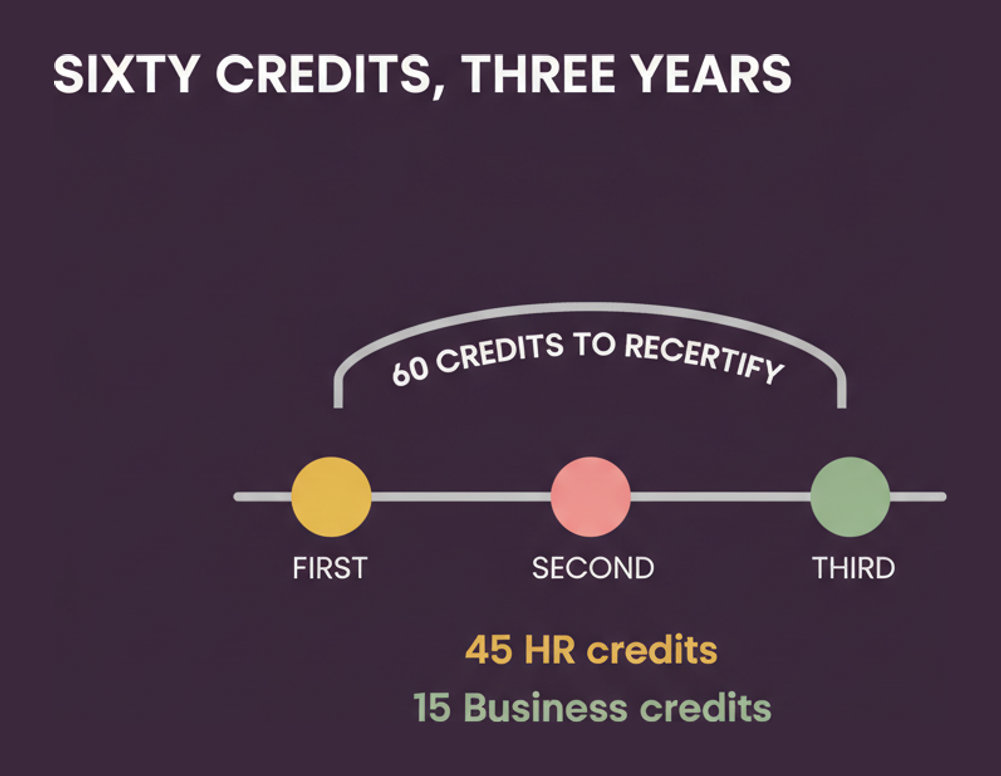
That business requirement is consistent with the exam’s own emphasis. A credential that puts a third of its weight on organisational strategy is unlikely to accept three years of purely HR-domain learning as evidence of currency, and the 15-credit business component enforces the same view of the role that the syllabus does.
Planned across three years it is modest, roughly 20 credits a year, and most senior practitioners accumulate them through work they would do anyway. Left to the final months it becomes a scramble, and the alternative is retaking a 140-item paper.
On the return side, the credential maps onto the senior end of the profession. Independent salary data for the HR director role shows the band this credential is aimed at, which is a fairer comparison than generalist HR pay given the eligibility floor.
Frequently Asked Questions
What are the SPHR certification requirements?
One of three routes: four years of professional-level HR experience with a master’s degree or higher, five years with a bachelor’s degree, or seven years of professional-level experience. Eligibility is assessed at application.
How many questions are on the SPHR exam?
One hundred and forty items are presented, of which HRCI scores 115 and treats 25 as unscored pretest questions. There is no way to identify which are which during the sitting.
What is the passing score for SPHR?
A scaled score of 500 on a range of 100 to 700; HRCI publishes no percentage cut score. The exam runs 150 minutes with a further 30 minutes of administration time, which works out at roughly 64 seconds per item across the 140 presented.
How much does the SPHR certification cost?
Four hundred and ninety-five US dollars for the exam plus a separate $100 application fee, so $595 for a first attempt. The application fee is spent whether or not you are found eligible.
Which SPHR functional area is the largest?
Leadership and Strategy at 33 percent, roughly 46 of the 140 items. It covers HR strategy development, contribution to organisational strategy, risk monitoring and the interpretation of business metrics.
What is the difference between SPHR and SPHRi?
SPHR is grounded in United States employment law and examines the applicability of US federal regulation to strategy. SPHRi is the international equivalent at the same level, without that US legal content.
How long is the SPHR certification valid?
Three years from the date of testing. Holders recertify by earning 60 credits in that window, split as 45 HR credits and 15 Business credits, or by retaking the exam.
Is the SPHR exam multiple choice?
Mostly. HRCI describes the scored questions as mainly multiple choice, and delivery runs through Pearson VUE. The items are typically framed as workplace scenarios rather than as definitions.
Does SPHR cover diversity, equity and inclusion?
Yes, in two places. Leadership and Strategy asks candidates to develop and evaluate DEI strategies, and Talent Management asks them to evaluate how DEI is integrated into workplace culture and make recommendations based on the findings.
Can you take SPHR without a degree?
Yes, through the seven-year route. HRCI states no degree requirement on that path, but the years must be professional-level HR experience rather than administrative or coordination work in an HR function.
Conclusion
The SPHR certification requirements are the first real test, not the exam. Four years with a master’s, five with a bachelor’s, or seven without, all measured in professional-level HR work, and assessed before HRCI will sell you a sitting. Clear that and the paper ahead is 140 items in 150 minutes, passed at a scaled 500, with a third of its weight on leading the function rather than running it.
Audit the years first, then study in weighting order and give Leadership and Strategy the time its 46 items deserve. Budget $595 for a first attempt and 60 recertification credits across the three years that follow, and the credential becomes a plan rather than a gamble.


