HR professionals look at the name, see Human Resources, and assume their years of employee relations work will carry them. Then they open the blueprint and find that 60 percent of it is system architecture and platform security. CIS-HR, the ServiceNow Certified Implementation Specialist – Human Resources exam, certifies that you can build HR service delivery rather than run HR, and that distinction is what catches people out.
The exam is 60 questions in 90 minutes for USD $450, scheduled through Pearson VUE, and the result is reported as pass or fail with no published percentage. This guide works through what the role actually involves, where the marks sit across the three domains, why security takes almost a third of an HR exam, and how the credential compares with the HR certifications an HR career usually points toward.
What Does a ServiceNow HR Implementation Specialist Actually Do?
A ServiceNow HR implementation specialist configures the platform that HR runs on. The work is building HR services and catalog items, wiring assignment rules so cases reach the right team, shaping the Employee Center that staff actually see, and locking down who can read a record. CIS-HR certifies that build capability, not HR judgement.
The practical difference shows up on day one of a deployment. An HR business partner decides what the parental leave policy should be. The implementation specialist decides which table the case sits on, which scoped application owns it, which role can open it, and what the employee sees when they search for it in the portal. Both jobs are necessary. Only one of them is on this exam.
Where the role sits in a delivery team
On most HR Service Delivery projects this person is the bridge between the HR function and the platform team. They translate a service catalogue that HR describes in policy language into record producers, criteria and lifecycle stages that the instance can execute. When something goes wrong after go-live, they are the ones asked why a case routed to the wrong group or why a manager can see a field they should not.
That bridging position is why the credential rewards people who already sit near an instance. Someone who has watched an HR deployment happen has seen the table structure, the scoping decisions and the security arguments play out in practice, and the blueprint reads like a description of things they have already argued about.
What Does the CIS-HR Exam Cost, and How Long Is It?
CIS-HR costs USD $450 and gives you 90 minutes to answer 60 multiple choice questions, delivered through Pearson VUE. The result comes back as pass or fail rather than a percentage, so there is no published cut score to aim at. That works out at 90 seconds per question, which is comfortable for recall and tight for anything you have to reason through.
| Item | Detail |
|---|---|
| Exam code | CIS-HR |
| Full name | ServiceNow Certified Implementation Specialist – Human Resources |
| Questions | 60 |
| Duration | 90 minutes |
| Format | Multiple choice |
| Result | Pass or fail, no published percentage |
| Fee | USD $450 |
| Delivery | Pearson VUE |
What a pass or fail result changes
Without a cut score you cannot plan to sacrifice a domain. On an exam reported as a percentage you can decide to write off the smallest area and make the marks up elsewhere. Here the smallest domain is still 30 percent, and you have no way of knowing how close a fail was, so even coverage is the only sensible strategy. Working through the blueprint alongside the CIS-HR exam page is the cheapest way to see whether your instance experience maps onto what is being asked.
The fee is also worth planning around properly. At $450 a retake is not trivial, and unlike a scored exam you will not get a domain breakdown telling you where to spend the second attempt.
Why Does Employee Center and Core HR Take Forty Percent?
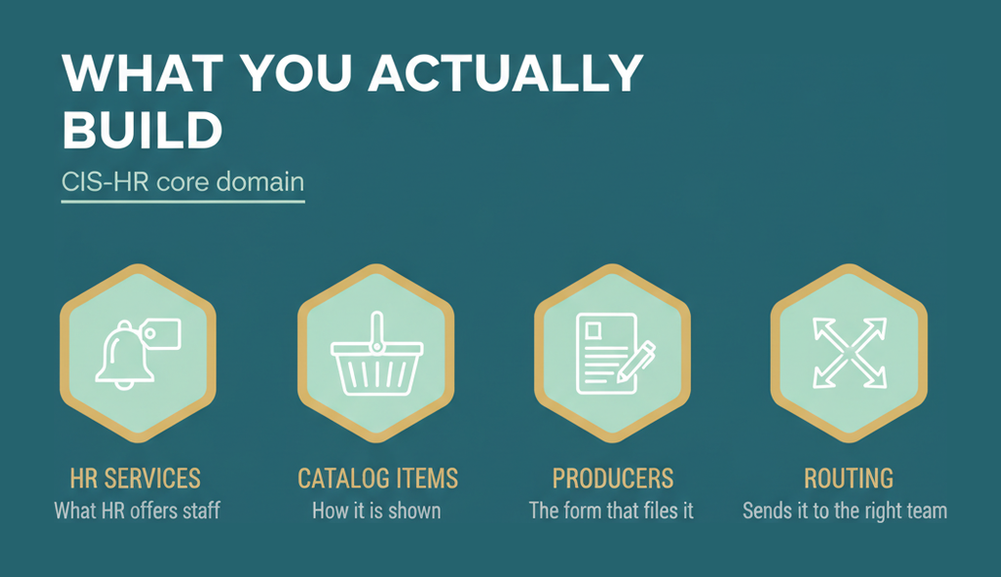
Configuring core HR applications and Employee Center is the single largest domain at 40 percent, because it is where the platform meets the employee. It covers users, groups, skills and roles, assignment rules, HR services, HR catalog items and record producers, and Employee Center branding. Nearly half the exam sits on what a real implementation spends most of its time on.
The four things this domain names
- Users, groups, skills and roles. Who exists in the instance, how they are grouped, and what each grouping is allowed to do.
- Assignment rules. The logic that sends a case to the right HR team rather than a general queue, which is where badly configured instances fail visibly.
- HR services, HR catalog items and record producers. The building blocks of the HR service catalogue, and the difference between them is a recurring source of confusion worth resolving before the exam.
- Employee Center branding. The presentation layer, which sounds cosmetic and is not, because adoption depends on whether staff can find anything.
The reason this weighting is defensible is that HR service delivery lives or dies on routing and findability. A technically perfect data model that sends every case to one overloaded group is a failed deployment, and the blueprint puts its heaviest weight exactly there.
Why record producers keep catching people out
An HR service describes what is offered. A record producer is the form that creates the record when somebody asks for it. A catalog item is how it is presented in the catalogue. Candidates who have used the platform as an end user rather than built on it tend to collapse all three into one idea, and the exam separates them deliberately.
What Does the HR System Architecture Domain Expect You to Know?
The architecture domain carries 30 percent and names three things: plugins, HR table structure, and application scoping. It is asking whether you understand how the HR product is assembled on the platform, not whether you can describe HR processes. This is the domain where platform people have an advantage over HR people.
HR table structure
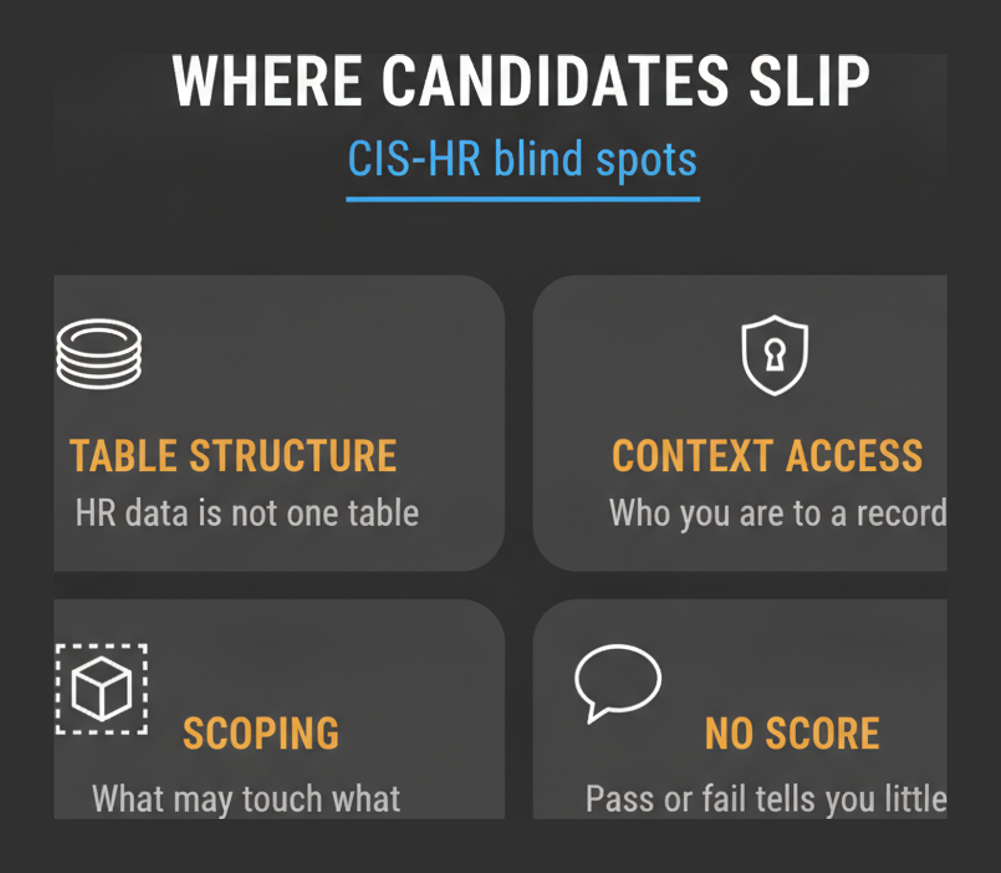
HR data does not sit in one table. Cases, profiles and the various HR services are spread across a structure with inheritance, and knowing which table a given record lives on determines what you can report on, what you can secure, and what breaks when you extend something. Most real implementation mistakes trace back to a misunderstanding at this level.
Application scoping
Scoping controls what one application is allowed to touch in another. In an HR context that is a governance question as much as a technical one, because HR data is exactly the data other applications should not be reaching into casually. Understanding scope boundaries is what stops a well-meaning integration from exposing something it should not.
Plugins
Plugins determine which HR capabilities are present in the instance at all. Knowing what a given plugin activates, and what depends on it, is the difference between diagnosing a missing feature in a minute and spending an afternoon looking for a configuration error that does not exist. The vendor’s own HR Service Delivery overview is a reasonable place to see which capabilities belong to the product before working out how they are switched on.
Why Does Security Take Thirty Percent of an HR Exam?
Platform, role and contextual security carries 30 percent because HR holds the most sensitive data in most organisations. The domain covers how platform, role and contextual security work together, how the Delegated Developer role operates, and how to configure security options specifically to protect HR data. Nearly a third of a Human Resources exam is about keeping people out.
Once you see the data involved, the weighting stops looking strange. Salary, grievance records, disciplinary history, medical accommodation, exit interviews. A misconfigured access rule in a service desk instance leaks a ticket about a broken laptop. The same mistake in an HR instance leaks a harassment complaint to the person it names.
Contextual security is the part that is genuinely different
Role-based access asks who you are. Contextual security asks who you are in relation to this specific record. A manager should see a case belonging to their own team member and not somebody else’s, and the same person is authorised in one context and not in another. That relational logic is what makes HR security harder than a permissions matrix, and it is why the blueprint calls it out by name.
The Delegated Developer role
Delegated Developer lets someone build within defined boundaries without holding full administrative rights. It exists precisely so that HR-side configuration can happen without handing over the instance. The exam expects you to know what those boundaries are, which is a governance question dressed as a technical one.
How Does CIS-HR Differ From PHR or SHRM-CP?
An HR certification tests HR judgement. CIS-HR tests platform configuration. PHR and SHRM-CP examine employment law, employee relations, total rewards and organisational strategy. CIS-HR examines table inheritance, scoping, assignment rules and access control. They point at different jobs, and holding one says almost nothing about the other.
| Question | CIS-HR | PHR or SHRM-CP |
|---|---|---|
| What is tested | Building HR service delivery on a platform | HR practice, law and strategy |
| Who it suits | Platform and HR systems roles | HR generalists and specialists |
| Largest weighting | Core HR applications and Employee Center, 40 percent | Varies by credential and level |
| Prior experience that helps | Time spent working on a ServiceNow instance | Time spent doing the HR job |
The honest answer for an HR professional weighing this up is that CIS-HR is the right choice only if the work is genuinely technical. If you configure the system, it fits. If you use the system, an HR credential will do more for you. The overlap between the two is smaller than the shared words Human Resources suggest, and the same confusion runs through the platform categories generally, which is why the HRIS and HCM distinction is worth being clear on before choosing a direction.
What the market pays for HR work
The Bureau of Labor Statistics puts the 2024 median pay for human resources specialists at $72,910 a year, with the lowest 10 percent under $45,440 and the highest 10 percent over $126,540, and projects 6 percent employment growth from 2024 to 2034. That spread is wide, and technical HR systems work sits toward the upper half of it rather than at the median. No certification guarantees movement within that range, but the range itself is a reasonable frame for deciding whether a technical specialism is worth the effort.
How Do You Prepare When the Result Is Only Pass or Fail?
Cover all three domains evenly, because the smallest is still 30 percent and a pass or fail result gives you no feedback to correct with. Spend the most time on core HR applications and Employee Center, since it carries 40 percent, and treat architecture and security as the two areas most likely to be underestimated by anyone coming from an HR background.
- Start with HR table structure, because almost everything else in the blueprint depends on understanding where a record actually lives.
- Move to core HR applications and Employee Center, working through HR services, catalog items and record producers until you can state the difference between them without hesitating.
- Build the assignment rule logic yourself in an instance rather than reading about it, since routing is the part that shows up as a real failure after go-live.
- Take the security domain next, treating contextual security as a separate idea from role-based access rather than an extension of it.
- Finish with plugins and application scoping, then test yourself across all three domains at 90 seconds a question to find the area you are quietly weakest in.
Hands-on time is the part that does not substitute. Reading about a record producer teaches you the definition; building one teaches you what the exam is actually asking about. If you have access to an instance, use it, and if you do not, that gap is the first thing to solve rather than the last.
It is also worth being deliberate about what you practise with, and why practice tests beat dumps matters more than usual on an exam that hands back no score breakdown to learn from. Booking is done through the Pearson VUE portal, and the wider credential family is set out on the ServiceNow certification pages.
Where HR-background candidates lose time
Almost always in architecture and security, and almost always because the vocabulary is unfamiliar rather than the concepts being hard. Scoping, inheritance and contextual access are ideas an HR professional can absolutely learn, but they have to be learned deliberately, and the 60 percent they represent between them is too large to pick up incidentally. Candidates from a platform background have the reverse problem and tend to underestimate how specific the HR catalogue structure is.
Frequently Asked Questions
How many questions are on the CIS-HR exam?
CIS-HR has 60 multiple choice questions and a 90 minute time limit, which works out at roughly 90 seconds per question.
What is the CIS-HR passing score?
There is no published passing percentage. The result is reported as pass or fail, so there is no cut score to aim at and no domain breakdown afterwards.
How much does the CIS-HR exam cost?
USD $450. Because there is no score report to learn from, a retake is an expensive way to find out where you were weak.
Where do you sit the CIS-HR exam?
It is scheduled through Pearson VUE.
How many domains does CIS-HR have?
Three. HR system architecture at 30 percent, core HR applications and Employee Center at 40 percent, and platform, role and contextual security at 30 percent.
Is CIS-HR a good certification for an HR professional?
Only if the work is technical. Around 60 percent of the exam is architecture and security, so it certifies platform build capability rather than HR practice. An HR generalist is usually better served by an HR credential.
Do you need ServiceNow experience before taking CIS-HR?
The blueprint assumes working familiarity with an instance. Table structure, scoping and assignment rules are difficult to learn from reading alone, so hands-on access matters more than study hours for this exam.
What is the difference between an HR service and a record producer?
An HR service describes what is offered. A record producer is the form that creates the record when somebody requests it. The exam separates the two deliberately, and conflating them is a common mistake.
Why does an HR exam test security so heavily?
Because HR holds an organisation’s most sensitive records, including salary, grievance and disciplinary data. A misconfigured access rule causes far more damage in an HR instance than in a service desk one, which is why the domain carries 30 percent.
What is contextual security in ServiceNow?
Role-based access asks who a user is. Contextual security asks who they are in relation to a specific record, so a manager can see a case belonging to their own team member and not another manager’s. That relational logic is what makes HR access control harder than a simple permissions matrix.
Conclusion
CIS-HR carries Human Resources in its name and spends 60 percent of its marks on system architecture and platform security. That is the single most useful thing to know before booking it. It is a build credential for people who configure HR service delivery, and it assumes you have spent real time inside an instance rather than real time inside an HR function.
If that describes your work, the blueprint is refreshingly short: three domains, 60 questions, and a heavy weighting on the catalogue and routing configuration that deployments actually live on. Cover all three evenly, since a pass or fail result gives you nothing to correct with, and get hands on a real instance before you sit down. If it does not describe your work, an HR certification will take you further, and knowing that now saves you $450.


