
The aPHRi is HRCI’s Associate Professional in Human Resources – International, an entry-level HR credential built for people working in HR roles outside the United States. The letters trip people up, so it is worth spelling out: the lower-case a stands for associate, and the trailing i marks it as the international version rather than the US one. What makes it unusual among HR credentials is the eligibility rule. Almost every professional-level HR certification asks for years of documented experience before you can even apply. This one asks for none, because it is a knowledge-based credential rather than an experience-based one. That makes aPHRi the realistic first step for career changers and graduates. This article covers who can sit it, its true cost, how the five domains are weighted, how it differs from the aPHR, and what keeping it involves.
What Is the aPHRi Certification?
The aPHRi certifies foundational knowledge of HR operations, recruitment, compensation, development and employee relations, assessed against practice outside the United States. It is the entry point to HRCI’s international credential family, which continues through PHRi for practitioners and SPHRi for senior professionals. It is a knowledge credential, not a competency assessment. HR people who end up running transformation work often pair it with the change management foundation certification, which sits outside the HRCI ladder.
That framing is deliberate. HRCI’s international ladder assumes people enter HR from many directions and in many labour markets, so the first rung tests whether you know how HR works rather than whether you have already done it. The domains cover the whole function at a shallow depth instead of one area in detail.
What accreditation does and does not cover here
The question behind most searches for an entry-level credential is whether an employer will take it seriously. For most of its credentials HRCI answers with external accreditation rather than its own claims. At the far end of the same ladder sits the global HR credential, aimed at practitioners running HR across several countries.
“NCCA accreditation is impartial, third-party confirmation that our programs are developed and administered to the highest standards of quality, integrity, and fairness – and a signal to employers and peers that the credential you hold signifies substantive expertise.”
The aPHRi is the exception to that statement. HRCI states that, with the exception of the aPHRi, its certification programmes are accredited by the National Commission for Certifying Agencies, and the aPHRi is also absent from the pass rates HRCI publishes each year. Its weight with an employer therefore rests on HRCI’s name and on the ladder it leads into, since the PHRi and SPHRi above it are both accredited, rather than on accreditation of its own. Background on human resource management as a discipline is worth reading first if the function itself is new to you.
Does aPHRi Really Require No HR Experience?
Yes. HRCI states plainly that no HR experience is required for this credential, because it is knowledge-based. There is no minimum number of years, no requirement to be currently employed in HR, and no supervisor sign-off. If you can pass the exam, you can hold the credential. The ladder ends at the senior international HR exam, which reverses that position entirely.
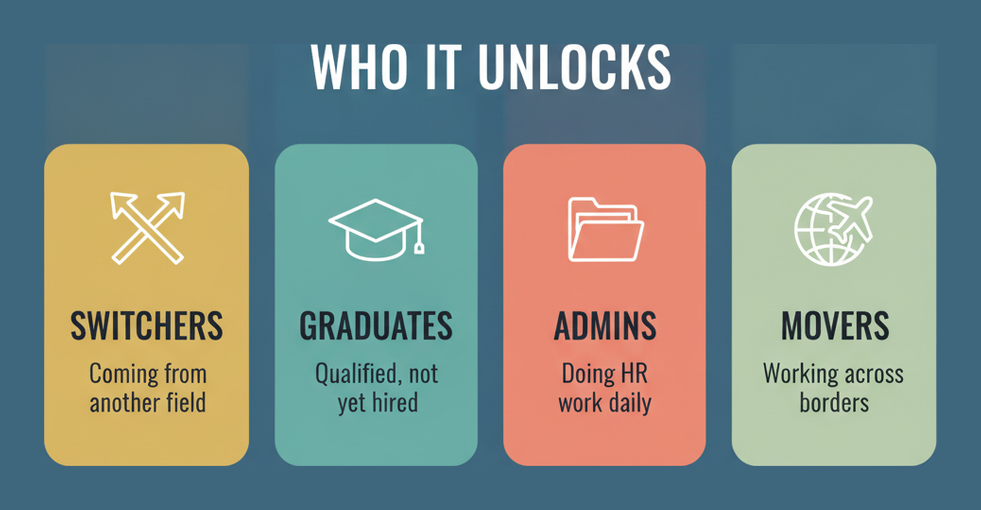
This is genuinely unusual and it is the main reason the aPHRi exists. Entry-level HR hiring is circular in most markets: employers want HR experience, and HR experience requires being hired into HR. A credential that can be earned before the first role breaks that loop, which is why the aPHRi appears so often in job applications from career changers and recent graduates. Once you have HR experience behind you, the next rung is set out in the PHRi exam format guide.
Who it actually helps
- Career changers moving into HR from administration, operations or customer-facing roles
- Graduates with an HR or business qualification but no working HR record
- Office administrators already doing HR tasks informally who want the function on their profile
- People working in markets where local HR qualifications carry limited cross-border recognition
Where it helps less is anyone who already has several years in the function. If that describes you, the exam will feel undemanding and the credential will understate your position; PHRi is the level that matches. The full international ladder is set out in the HRCI certification catalogue.
What Does the aPHRi Exam Cost and How Long Is It?
The aPHRi costs $300 USD for the exam plus a separate $100 USD application fee, so the real total is $400. The exam runs 105 minutes with a further 30 minutes of administration time, and presents 90 multiple choice questions. HRCI scores it on a scaled range of 100 to 700 with 500 needed to pass, and it is delivered through Pearson VUE.
| Exam detail | Value |
|---|---|
| Credential | Associate Professional in Human Resources – International |
| Exam fee | $300 USD |
| Application fee | $100 USD |
| Total cost | $400 USD |
| Questions | 90, of which 65 are scored |
| Duration | 105 minutes, plus 30 minutes administration |
| Passing score | 500 on a scaled range of 100 to 700 |
| Format | Multiple choice |
| Languages | English and Arabic |
| Delivery | Pearson VUE test centre or OnVUE remote proctoring |
| Experience required | None |
Two details in that table repay attention. The application fee is separate and non-refundable, which means the advertised $300 is not the number to budget for. And of the 90 questions, only 65 are scored: the other 25 are unscored pretest items HRCI is trialling for future papers.
The pretest split has a practical consequence. Roughly one question in four does not count, and you cannot tell which. A question that seems oddly worded or unexpectedly obscure may simply be one HRCI is testing, so the right response is to answer it and move on rather than let it unsettle the rest of the paper.
You can sit the exam at a Pearson VUE centre or remotely through OnVUE from home or office, which matters for candidates in markets where the nearest test centre is a long way away.
How Are the Five aPHRi Domains Weighted?
The syllabus publishes weightings for all five domains, and they are unevenly distributed. HR Operations takes a third of the paper on its own, while Human Resource Development and Retention takes a tenth. Study time should follow that split rather than treating the five as equal.
| Domain | Weight | Roughly how many scored questions |
|---|---|---|
| HR Operations | 33% | 21 |
| Recruitment and Selection | 22% | 14 |
| Employee Relations, Health, and Safety | 20% | 13 |
| Compensation and Benefits | 15% | 10 |
| Human Resource Development and Retention | 10% | 7 |
Read as a pair, HR Operations and Recruitment and Selection are 55% of the paper between them. Add Employee Relations, Health and Safety and three domains account for three quarters of the scored questions. Compensation and Benefits and Development and Retention together make up a quarter, which is enough to fail on but not enough to justify equal time.
What the smallest domain still expects
At 10%, Human Resource Development and Retention is the one candidates skim, and it is short but specific: training delivery formats, techniques for evaluating training programmes, career development practices such as succession planning and dual career ladders, and performance appraisal and management methods. Seven scored questions is small, but it is more than the margin most people pass by.
Why Is HR Operations a Third of the Exam?
Because it is the widest domain by content as well as by weight. HR Operations covers organisational strategy and culture, the legal and regulatory environment, confidentiality and privacy of employee data, HR metrics, HRIS systems, job classifications and descriptions, reporting structures, external HR service providers, and communication techniques. It is effectively the whole administrative spine of the function.
For a candidate with no HR background this is also the least intuitive domain, because much of it is vocabulary rather than reasoning. Knowing that cost per hire, time to recruit and turnover rate are the standard HR metrics is a recall task. So is knowing what an HRIS does, or the difference between a matrix and a flat reporting structure.
The parts that carry weight
- HR metrics and how each is calculated and used
- Employee records management, including retention and disposal, and the privacy rules around it
- Job classifications, which cover hourly, salary, full-time, part-time and contractor distinctions
- Types of external HR provider, from recruitment firms to benefits brokers and staffing agencies
- Methods for collecting and presenting workforce data
One thing worth flagging about the international framing: the domain references the legal and regulatory environment without tying it to any single jurisdiction. The exam tests the concept of complying with employment law rather than the content of any particular country’s law, which is precisely what makes the credential portable.
What Is the Difference Between aPHR and aPHRi?
The aPHR is HRCI’s United States credential and the aPHRi is its international counterpart. Both sit at the same level and both require no prior HR experience. The difference is the legal and regulatory context the exam assumes: aPHR tests against US employment law, while aPHRi is written to be applicable across markets rather than tied to one.
| Question | aPHR | aPHRi |
|---|---|---|
| Intended market | United States | HR roles outside the United States |
| Legal context | US employment law and regulation | General regulatory concepts, not jurisdiction-specific |
| Experience required | None | None |
| Next step up | PHR | PHRi |
Choosing between them is genuinely simple: pick the one that matches where you intend to work, not where you currently live. Someone in the Gulf planning to stay there wants aPHRi. Someone abroad who is actively moving to the United States is better served by aPHR, because the domestic version’s legal grounding is what US employers recognise.
The trap is assuming aPHRi is a lesser version of aPHR. It is not; it is the same level with different contextual assumptions. HRCI’s own description of the credential and its current fees sit on the official aPHRi page, and the surrounding family is listed in the HRCI credential directory.
What Happens After You Pass?
The credential runs on a three year cycle, and keeping it requires 45 recertification credits within that period. Credits come from continuing professional development: courses, conferences, webinars, on-the-job HR projects and similar activity. There is no requirement to resit the exam if you maintain the credits.
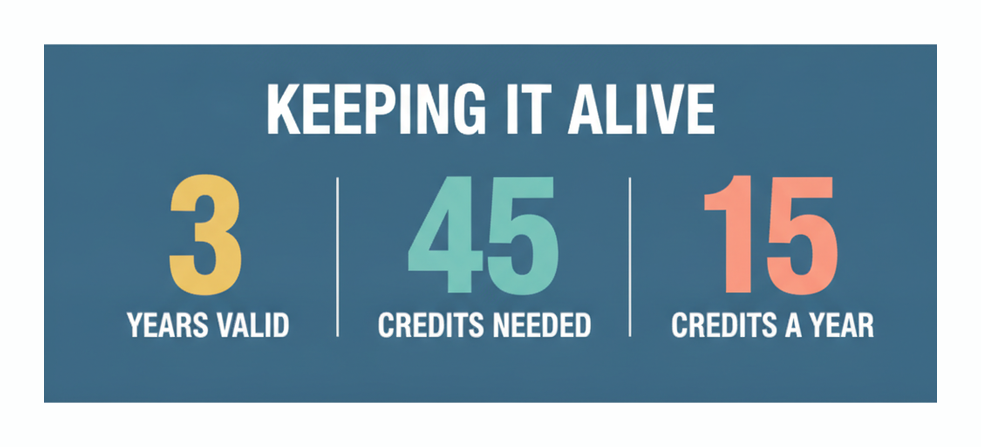
Forty-five credits over three years is fifteen a year, which is a manageable pace for anyone actually working in HR and a real commitment for anyone who is not. That asymmetry is worth thinking about before you sit the exam rather than after. If the credential is meant to get you into the function, the plan needs to include getting into the function, because otherwise the recertification clock starts running against a career that has not begun.
Where it leads
The natural progression is PHRi, HRCI’s international practitioner credential, which does carry experience requirements. Most people who take that step do so after two or three years in a role that the aPHRi helped them reach. In pay terms, the credential rarely moves compensation on its own; the role does. Current benchmarks for the entry-level roles this credential typically leads to are tracked on PayScale HR assistant data.
How Should You Prepare for 90 Questions?
Let the weightings set the timetable and treat the exam as a vocabulary problem rather than a reasoning one. With no experience assumed, almost everything on this paper is a term, a method or a category you either recognise or do not. That makes it very learnable, and it makes recall drills more valuable than deep reading.
- Budget your study time in proportion to the weightings, giving HR Operations roughly a third of it and Development and Retention roughly a tenth, rather than treating the five domains as equal.
- Start with HR Operations, because it is both the largest domain and the most vocabulary-heavy, which means it takes the longest to become automatic.
- Build a list of every HR metric and definition the syllabus names, since terms like cost per hire, time to recruit and turnover rate are exactly what a knowledge-based exam asks about.
- Learn the interviewing and selection methods by name, keeping structured, unstructured, behavioural, situational and panel formats clearly distinct from one another.
- Work through compensation vocabulary separately, because payroll and benefits terminology is the area candidates from non-HR backgrounds find most alien.
- Read the employee relations and safety material last, as it is the most intuitive of the five domains and revises quickly.
- Sit timed practice papers at 90 questions in 105 minutes, and treat any question that feels strange as a possible unscored pretest item so it does not derail your pacing.
For a structured overview of the credential and its preparation material, the aPHRi exam overview collects the details in one place, and the existing aPHRi credential page covers the surrounding context.
Frequently Asked Questions
What does aPHRi stand for?
Associate Professional in Human Resources – International. The lower-case a marks the associate level, and the trailing i distinguishes it from the aPHR, which is HRCI’s United States credential.
Do you need HR experience to take the aPHRi?
No. HRCI states that no HR experience is required because it is a knowledge-based credential. There is no minimum service, no current-employment requirement and no supervisor verification.
How much does the aPHRi certification cost?
The exam fee is $300 USD and there is a separate application fee of $100 USD, so the total is $400. Budget for both, since the application fee is charged whether or not you go on to pass.
How many questions are on the aPHRi exam?
Ninety multiple choice questions, of which only 65 are scored. The remaining 25 are unscored pretest items, and there is no way to tell which questions fall into that group while you sit the exam.
How long is the aPHRi exam?
One hundred and five minutes of exam time, with a further 30 minutes of administration time on top. That gives you a little over a minute per question, which is comfortable for recall-based items.
What is the aPHRi passing score?
A scaled 500 on HRCI’s range of 100 to 700. It is not a percentage, and HRCI publishes no pass rate for the aPHRi. Because the domains are unevenly weighted, strength in HR Operations and Recruitment and Selection carries far more of the result than strength in the smaller domains.
How long is the aPHRi valid?
Three years. Keeping it current requires 45 recertification credits across that cycle, earned through continuing professional development rather than by resitting the exam.
Can you take the aPHRi exam from home?
Yes. HRCI offers it either at a Pearson VUE test centre or remotely through OnVUE from home or office, which matters in markets where test centres are sparse.
Which domain is the largest?
HR Operations at 33%, roughly 21 of the 65 scored questions. It covers organisational strategy, the regulatory environment, employee records, HR metrics, HRIS, job classifications and reporting structures.
Should you take aPHR or aPHRi?
Choose by where you intend to work. aPHR assumes United States employment law; aPHRi is written for HR roles elsewhere and avoids tying its regulatory content to any single jurisdiction.
Conclusion
Two things make this credential worth understanding properly. The first is that it asks for no experience at all, which makes it one of the few HR qualifications you can hold before your first HR role rather than after it. The second is that its domains are weighted steeply: HR Operations alone is a third of the paper, and the two smallest domains together are only a quarter. Study in that proportion, treat the material as vocabulary to be recalled rather than argued about, and remember that the advertised $300 becomes $400 once the application fee is added and that the credential needs 45 credits every three years to stay alive. Check the five domain weightings against what you already know, and let the gaps decide where your study time goes.


