
No other American state has its own HR credential. There is no PHR for Texas, no certification in New York employment practice, no Illinois equivalent. California has one, and the reason is not parochialism. It is that an HR professional can follow federal law faithfully in California and still be exposed, because the state layers its own rules on top and those rules usually go further.
The PHRca exists to test exactly that gap. This guide covers what the exam contains, how its five domains are weighted, why compliance carries almost a third of the paper, and whether it belongs beside your PHR or instead of it.
Table of Contents
- Why Does California Get Its Own HR Certification?
- What Does the PHRca Exam Look Like?
- How Are the Five PHRca Domains Weighted?
- Why Does Compliance and Risk Management Carry the Most Weight?
- What Makes California Wage and Hour Rules So Different?
- Which Leave Entitlements Does the Exam Expect You to Untangle?
- How Does the Employment Lifecycle Domain Test You?
- Should You Take the PHRca or the PHR?
- Who Actually Needs This Credential?
- How Should You Prepare for a State-Specific Exam?
- Frequently Asked Questions About the PHRca
- Conclusion
Why Does California Get Its Own HR Certification?
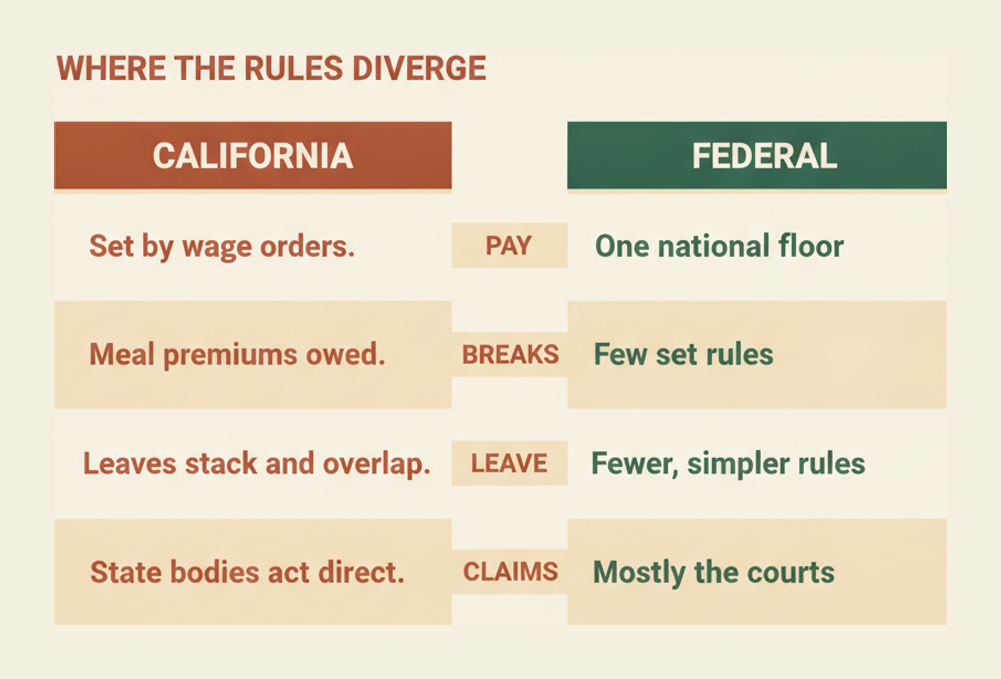
The PHRca exists because California employment law operates as a parallel system rather than a set of local variations. Wage Orders, meal and rest break rules, classification tests, and leave entitlements all differ from the federal baseline, and in nearly every case the state standard is the stricter one. Compliance built on federal knowledge alone fails here.
That is a genuinely unusual situation, and it is why a credential scoped to one state can be defensible rather than gimmicky. The people who hold it are not demonstrating broader HR knowledge. They are demonstrating that they can operate inside a specific and unforgiving regulatory environment.
“California employment law is layered, intricate, and constantly evolving.”
A Credential That Tracks a Moving Target
The state legislature revises employment law every year, which means the exam is testing a body of knowledge that does not sit still. Preparation built on material more than a couple of years old carries real risk, and that is truer for the PHRca than for most certifications.
What Does the PHRca Exam Look Like?
The PHRca presents 115 multiple choice questions in 135 minutes, with an additional 30 minutes of administration time in the appointment. HRCI reports results on a scaled score from 100 to 700 with 500 needed to pass, and the total cost is USD $495 once the application fee is added to the exam fee.
| Specification | Detail |
|---|---|
| Exam name | HRCI Professional in Human Resources – California |
| Exam code | PHRca |
| Number of questions | 115 (90 scored, 25 unscored pretest) |
| Exam duration | 135 minutes plus 30 minutes administration time |
| Passing score | 500 on a scaled range of 100 to 700 |
| Question format | Multiple choice |
| Exam fee | USD $395 |
| Application fee | USD $100 |
| Delivery | Pearson VUE |
Reading That Passing Score Correctly
The 47 percent figure often attached to the PHRca is not a pass mark. It is HRCI’s published pass rate, the share of candidates who passed, as of 31 December 2025. The mark you need is a scaled 500 on a range of 100 to 700, the same threshold HRCI applies to all of its exams. That 47 percent is the lowest pass rate of any HRCI credential, which says more about how hard this paper is than any cut score could. Candidates who treat a single domain as optional tend to discover the mistake too late.
How Are the Five PHRca Domains Weighted?
The PHRca body of knowledge divides into five domains with published percentage weightings. The split tells you something important about the credential’s character: it is a compliance exam first and a people management exam second.
| Domain | Weight |
|---|---|
| Compliance and Risk Management | 29% |
| Employment Lifecycle and Employee Relations | 26% |
| Compensation/Wage and Hour | 21% |
| Leaves of Absence and Benefits | 14% |
| Health, Safety and Workers’ Compensation | 10% |
Compliance and Risk Management alone carries 29 percent, and Compensation adds another 21 percent. Together those two account for half the paper. The full PHRca exam syllabus breaks each domain into named responsibilities, which is the level of detail worth studying against.
Why Does Compliance and Risk Management Carry the Most Weight?
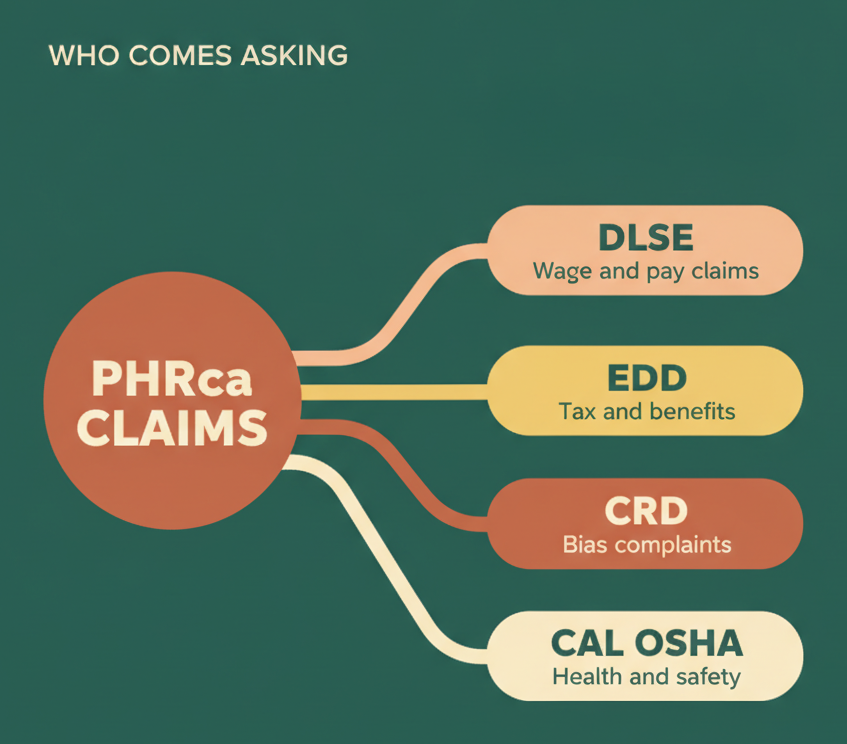
Compliance and Risk Management is the largest PHRca domain at 29 percent because California enforcement is administrative and active rather than purely litigious. Several state agencies can open an inquiry directly, and the exam expects you to know which one is asking and what a proper response looks like.
The Agencies You Are Expected to Recognise
- Division of Labor Standards Enforcement handling wage claims and labour code enforcement
- Employment Development Department covering unemployment, disability, and payroll tax matters
- Civil Rights Department, renamed from the Department of Fair Employment and Housing in July 2022, for discrimination and harassment complaints
- Workers’ Compensation Appeals Board for contested compensation claims
- Cal/OSHA for workplace health and safety enforcement
Questions in this domain tend to be situational. You are given a scenario and asked what the correct next step is, which rewards candidates who have actually handled an agency letter over those who have only read about one.
What Makes California Wage and Hour Rules So Different?
Compensation and Wage and Hour carries 21 percent of the PHRca and is where the gap between federal and state practice is widest. The syllabus opens this domain by requiring candidates to identify the proper Wage Order for their organisation, industry, or profession, which has no federal equivalent at all.
Wage Orders Come First
California regulates by industry through Wage Orders issued by the Industrial Welfare Commission, and the applicable order changes what the rules are. Getting the order wrong means getting everything downstream wrong. The published Wage Orders by industry are the reference the exam assumes you can navigate.
Where Candidates Lose Marks
- Classification of independent contractors against employees, and exempt against non-exempt, under state tests rather than federal ones
- Meal periods and rest breaks, including the premium owed when one is missed
- Split shifts, reporting pay, and makeup time, which have no federal analogue
- Alternative work week schedules and the process required to adopt one
- Final pay timing, where deadlines are strict and penalties accrue daily
Which Leave Entitlements Does the Exam Expect You to Untangle?
Leaves of Absence and Benefits is 14 percent of the PHRca, and its difficulty is disproportionate to its weight. California leave entitlements stack, overlap, and run concurrently in combinations that federal-only practitioners rarely encounter, and the exam tests the interactions rather than the individual entitlements.
You are expected to track leave documentation and time correctly and to understand how wage replacement integrates with leave. A candidate who can recite each entitlement separately but cannot say what happens when two apply at once is not ready for this domain.
How Does the Employment Lifecycle Domain Test You?
Employment Lifecycle and Employee Relations is the second largest PHRca domain at 26 percent and runs from recruitment through separation. California constrains the hiring process specifically, so several of its requirements land before an employee has been hired at all.
Expect pre-employment practice covering background and credit checks, ban-the-box restrictions, limits on asking about wage history, and rules on employing minors. At the other end, termination risk is examined directly, including separations during leave, severance, and wrongful termination exposure. This is the domain where employee relations judgement and legal constraint meet, and the exam does not let you separate them.
Should You Take the PHRca or the PHR?
They answer different questions, and for many California practitioners the honest answer is both. The PHR certifies general HR competence across the federal landscape. The PHRca certifies that you can operate in California specifically, and it assumes rather than teaches the general foundation.
The PHRca is not a substitute for a broad HR credential and is not marketed as one. If your entire career will be spent inside California, it is arguably the more useful of the two, because it maps to the risk your employer actually carries. If you expect to move states or work nationally, the general credential travels and this one does not. A side by side look at the PHR certification domains makes the difference in scope obvious.
Who Actually Needs This Credential?
The PHRca is worth holding when California exposure is a real part of your job rather than an occasional footnote. Because the credential is narrow by design, its value is concentrated rather than broad, and that concentration is the point.
- HR generalists and managers employed by California-based organisations
- Multi-state HR teams where one person owns California compliance for everyone
- Payroll and compensation specialists applying Wage Orders and premium rules daily
- HR consultants and advisors serving California clients who expect state fluency
- Employment law support staff working alongside counsel on state matters
Compensation for HR roles varies by market, and current HR generalist pay data are a better guide than any single figure. Eligibility and recertification terms are set out on the official PHRca certification page, and testing runs through Pearson VUE scheduling.
How Should You Prepare for a State-Specific Exam?
Preparation for the PHRca differs from general HR study in one crucial way: currency matters more than breadth. California amends employment law annually, so the most common preparation failure is studying accurate material that has simply gone out of date.
A Sequence That Fits the Weighting
- Check the currency of every source first. Anything more than two years old needs verifying before you trust it.
- Start with compliance and wage and hour. They are half the exam between them.
- Learn the Wage Order logic before the details. Identifying the right order is the gate to everything else.
- Map the agencies to their remits. Situational questions hinge on knowing who is asking.
- Practise leave interactions, not leave lists. The exam tests what happens when entitlements overlap.
- Work scenario questions. This exam asks what you would do far more than what a rule says.
Candidates working to a tight budget will find this PHRca study plan a practical companion for sequencing the same material without buying every available resource.
Frequently Asked Questions About the PHRca
How many questions are on the PHRca exam?
The PHRca has 115 multiple choice questions, 90 scored and 25 unscored pretest items, with a duration of 135 minutes plus 30 minutes of administration time within the appointment. That gives you a little over one minute per question on average.
What is the passing score for the PHRca?
HRCI reports a scaled score between 100 and 700, and 500 is the pass mark. The 47 percent figure sometimes quoted is HRCI’s published PHRca pass rate, the share of candidates who passed, not the score you need.
How much does the PHRca cost in total?
The exam fee is USD $395 and the application fee is USD $100, giving a total of USD $495. Budget separately for study materials, since the application fee covers eligibility processing rather than preparation.
Which PHRca domain is the largest?
Compliance and Risk Management is the largest domain at 29 percent, followed by Employment Lifecycle and Employee Relations at 26 percent. Compensation and Wage and Hour follows at 21 percent.
Do I need the PHR before taking the PHRca?
No. The PHR is not a prerequisite. HRCI instead asks for professional-level HR experience: one year with a master’s degree or higher, two years with a bachelor’s degree, or four years on its own. Many practitioners hold both credentials anyway.
Is the PHRca useful outside California?
Its direct value is concentrated in California employment practice. It becomes useful elsewhere when a multi-state organisation needs someone to own California compliance centrally, which is a common arrangement in national HR teams.
What is a Wage Order and why does it matter?
California regulates working conditions by industry through Wage Orders issued by the Industrial Welfare Commission. Identifying the correct order for your organisation determines which rules apply, so an error there invalidates everything downstream.
How current does my study material need to be?
Very current. California amends employment law annually, so material more than about two years old risks teaching superseded rules. Verify anything older against the current position before relying on it.
Which agencies does the exam expect me to know?
The syllabus names the Division of Labor Standards Enforcement, the Employment Development Department, the Department of Fair Employment and Housing, the Workers’ Compensation Appeals Board, and Cal/OSHA. Questions often turn on which one is involved.
Does the PHRca require recertification?
Yes. The PHRca is valid for three years, and keeping it means earning 60 recertification credits in that window, 45 in HR and 15 specific to California, or retaking the exam. Given how quickly California law changes, that requirement carries real weight.
Conclusion
The PHRca is narrow on purpose. One state, 115 questions, and a domain split that puts compliance and wage and hour together at half the paper. That shape tells you how to prepare: start with the Wage Order logic and the agency map, treat leave as a problem of interactions rather than a list, and work scenario questions rather than definitions.
It will not travel with you to another state, and it is not trying to. What it does is certify that you can be trusted with the compliance risk a California employer actually carries, which for the right practitioner is worth considerably more than a broader credential would be.


