
Twenty-five of the questions you answer on this paper do not count toward your result. You will not know which twenty-five, they look exactly like the rest, and you have to treat every one of them as though your certification depends on it. HRCI is trialling them for future exams while you sit there.
The GPHR certification is HRCI’s Global Professional in Human Resources credential. The exam runs 125 items over 2 hours and 15 minutes, of which 100 are scored and 25 are unscored pretest questions, across six weighted functional areas from strategic global HR down to risk and compliance.
Table of Contents
- Why do 25 of the 125 GPHR questions not count?
- Are you eligible for the GPHR exam?
- What does GPHR cost, and what is the application fee for?
- How is GPHR scored, and where does 56 percent come from?
- What do the six GPHR functional areas cover?
- Why strategic global HR carries a quarter of the exam
- What does GPHR recertification require?
- How should you prepare for a global HR paper?
- Frequently Asked Questions
- Conclusion
Why do 25 of the 125 GPHR questions not count?
HRCI seeds every GPHR sitting with 25 unscored pretest items alongside the 100 that count. The pretest questions are candidates for future exams, and answering them lets HRCI measure how they perform against a real population before committing them to a scored paper. You are given no indication which is which.
This is standard practice for accredited credentialing bodies and it is the honest way to build a question bank, but it changes the arithmetic of the sitting in a way worth understanding. You are allotted 135 minutes for 125 items, which is roughly 65 seconds each, and a fifth of that effort produces no marks at all.
| Field | Value |
|---|---|
| Exam name | HRCI Global Professional in Human Resources |
| Exam code | GPHR |
| Items presented | 125 |
| Items scored | 100 |
| Unscored pretest items | 25 |
| Testing time | 2 hours 15 minutes, plus 30 minutes administration time |
| Format | Mostly multiple choice |
| Exam fee | USD 495 |
| Application fee | USD 100 |
| Delivered by | Pearson VUE |
| Functional areas | 6, weighted |
The practical advice that follows is unglamorous: do not try to spot them. Candidates who convince themselves a question is a pretest item and give it less attention are guessing, and a wrong guess about a scored item costs a mark they cannot get back.
Are you eligible for the GPHR exam?
GPHR has an eligibility gate before the exam, and HRCI publishes three routes through it. You need at least two years in a professional-level HR role plus a master’s degree or higher, or at least three years plus a bachelor’s degree, or at least four years with less than a bachelor’s degree. Less formal education means more years.
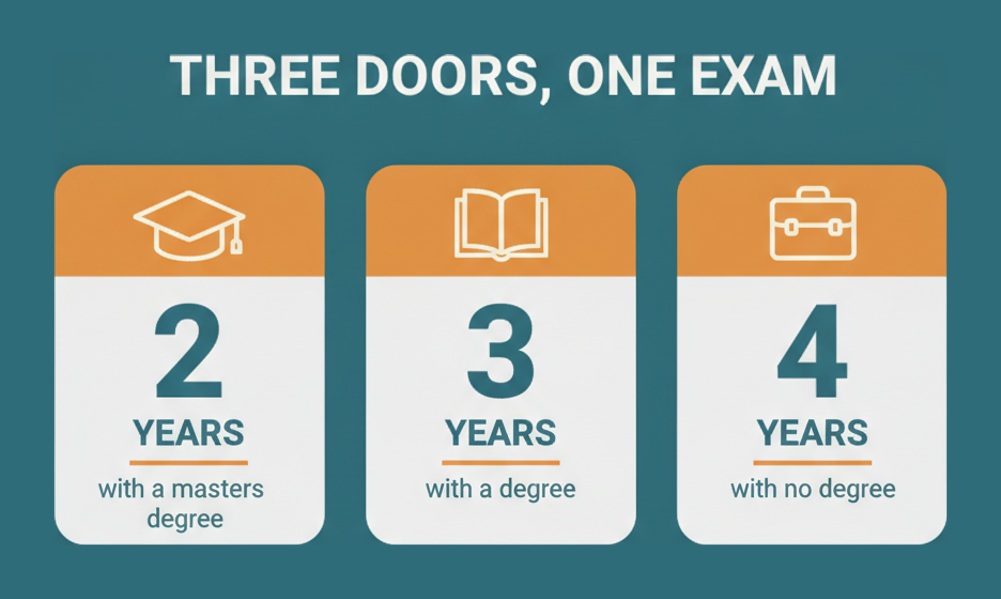
That structure is deliberate and it is worth reading the way HRCI intends it. The credential is not testing whether you have studied global HR; it is testing whether you have practised it, and the education tiers exist so that a practitioner without a degree is not shut out, only asked for more evidence of practice.
| Education | Professional-level HR experience required |
|---|---|
| Master’s degree or higher | At least 2 years |
| Bachelor’s degree | At least 3 years |
| Less than a bachelor’s degree | At least 4 years |
The phrase doing the work here is professional-level. Administrative HR time does not count toward it, and an application that stretches the definition is the kind of thing an audit picks up. Check your own history against the routes before spending anything, and if you want the credential’s full scope beside the eligibility rules, the money site’s GPHR certification overview sets the two out together.
What does GPHR cost, and what is the application fee for?
GPHR costs USD 495 for the exam plus a USD 100 application fee, so USD 595 in total before any study materials. The two charges are separate for a reason: the application fee buys the eligibility review, and it is spent whether or not your application is approved.
That ordering catches people out. You are not buying an exam booking and having your experience checked as a formality afterwards. You are paying HRCI to decide whether you qualify, and only then paying to sit. Anyone whose experience sits close to a route boundary should treat the USD 100 as the real decision point.
The costs after the fee
There is no mandatory training purchase, which distinguishes GPHR from credentials that bundle an approved course into the price. The genuine additional cost is time: the syllabus spans employment practice across multiple jurisdictions, and nobody works in all of them.
How is GPHR scored, and where does 56 percent come from?
HRCI does not publish a percentage passing score for GPHR or for any of its credentials. Results are reported as a scaled score between 100 and 700, and 500 is the mark required to pass. A 56 percent figure circulates widely and is repeated on many summary pages, including some that ought to know better, and it is not the passing score.
Fifty-six percent is HRCI’s published GPHR pass rate. HRCI reports it on its published pass rates, headed as of 31 December 2025, because accreditation obliges accredited programmes to release pass-rate data annually. It describes how many candidates passed, not how much of the paper you need to get right.
Why the two get confused
Both are percentages attached to the same exam, and if you meet the number without its label a swap is easy to make. The distinction matters in a very practical way: a pass rate tells you something about the population sitting the exam, while a cut score would tell you what to aim for, and only one of those is actionable.
Reading the pass rates as what they are is genuinely useful. GPHR’s 56 percent is the second lowest of HRCI’s published figures, ahead only of the California credential at 47, and well behind PHRi at 84. That is a real signal about difficulty, and it is a better one than an invented cut score.
What a scaled score actually means
A scaled score is a transformation of your raw mark, applied so that every form of the exam is measured against the same standard even though the question sets differ. HRCI applies the same 100 to 700 scale across its credentials. If your result falls between 100 and 499 you did not pass, and the closer to 500 it sits, the closer you came.
Because the transformation is not published, there is no way to convert 500 back into a number of correct answers, which is exactly why no honest source quotes one. The official GPHR credential page is the place to confirm the current mechanics before you book.
What do the six GPHR functional areas cover?
GPHR is built on six weighted functional areas: strategic global human resources at 25 percent, global talent management at 20 percent, global mobility at 15 percent, workplace culture at 15 percent, total rewards at 15 percent and risk management and compliance at 10 percent. Each is expressed as a list of responsibilities rather than topics.
| Functional area | Weight | What it examines |
|---|---|---|
| Strategic Global Human Resources | 25% | Aligning HR strategy with global business strategy, workforce planning and restructuring across borders, designing a global HR delivery model, organisation design, outsourcing and shared services, HR metrics, and the HR side of mergers, acquisitions and divestitures |
| Global Talent Management | 20% | Sourcing, developing and retaining people across markets with different labour conditions and different expectations of a career |
| Global Mobility | 15% | Assignment planning, localising expatriates, and the repatriation that most organisations handle badly |
| Workplace Culture | 15% | Cultural difference and its practical consequences, corporate social responsibility, ethics programmes, and the standards bodies that shape them |
| Total Rewards | 15% | Reward strategy against statutory and market requirements, supplemental pay, hardship and hazard elements, and the two main retirement plan types |
| Risk Management and Compliance | 10% | Anti-discrimination and anti-bullying programmes, global investigations, data protection including GDPR principles, and anti-bribery law |
Two things stand out from the responsibility lists. The first is how much named law appears: the US Foreign Corrupt Practices Act, the UK Bribery Act, the General Data Protection Regulation and the Safe Harbor privacy principles all show up by name. The second is how much of the exam is comparative rather than procedural.
Why strategic global HR carries a quarter of the exam
Strategic global human resources is the largest area at 25 percent because it is the one that makes GPHR a global credential rather than an HR credential taken by someone with an international job title. Its responsibilities are about operating a function across jurisdictions, not about running HR well in one of them.
The delivery-model question is a good illustration. The syllabus asks you to design a global HR delivery model and names the options, from regional and global centres of excellence to business partnering and fully decentralised arrangements, with time zone coverage listed as a design factor in its own right. That is a genuinely different problem from choosing an HR structure for one country.
The standards bodies are examinable
Workplace culture names the International Labour Organization explicitly among the bodies whose work shapes global employment practice. The ILO’s international labour standards are the reference point behind a great deal of what multinational employers treat as baseline, and knowing what the organisation actually produces is worth more than memorising its acronym.
Metrics appear more often than candidates expect
The strategic area lists common HR metrics by name, including cost per hire, engagement, employee net promoter score, time to fill, return on investment, turnover rate and the return on an overseas assignment. That last one is specific to this credential and is the sort of item that separates a global practitioner from a domestic one.
What does GPHR recertification require?
GPHR is valid for three years. To keep it you need 60 recertification credits across that period, and they are not interchangeable: 45 must be general HR credits and 15 must be Global credits specifically. The alternative is to retake the exam.
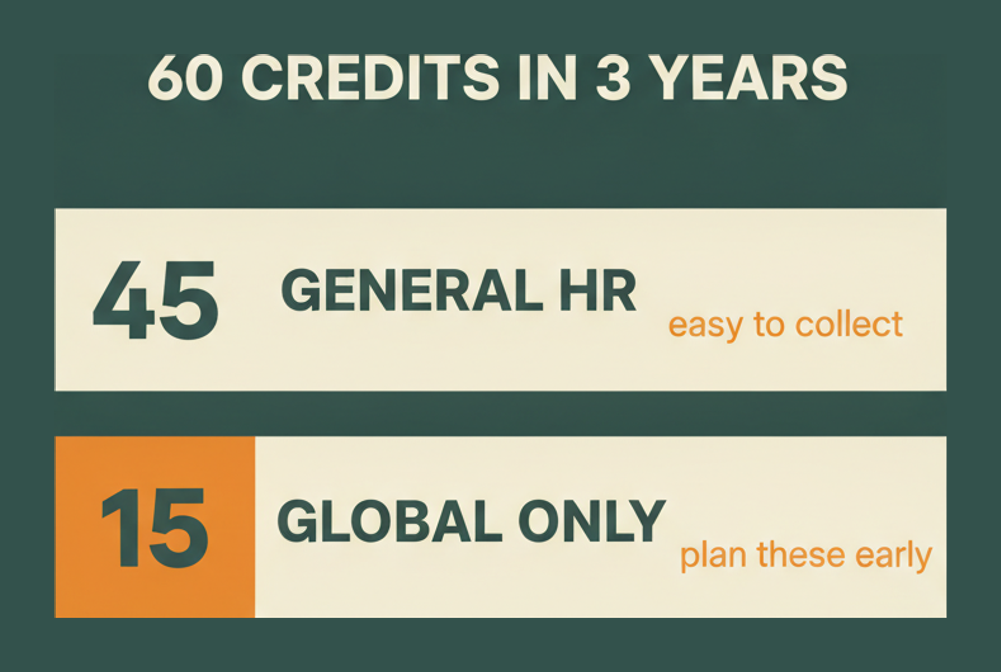
The 15 Global credits are the part that needs planning. General HR learning is abundant and easy to accumulate almost by accident, while activity that qualifies as global is narrower and tends to need a deliberate choice, whether that is international employment law updates, cross-border mobility content or work on a genuinely multinational project.
Why the split exists
It prevents the credential from drifting. A GPHR holder who spent three years accumulating domestic HR credits would emerge recertified in a global credential without having touched anything global, and the 15-credit floor stops exactly that. Treated as a design feature rather than an obstacle, it is one of the more sensible recertification rules in the field.
Anyone weighing this against HRCI’s other international credentials will find the credit structures differ, and the earlier GPHR study guide on this site covers the preparation side in more depth than there is room for here.
How should you prepare for a global HR paper?
GPHR preparation is unusual because the hard part is rarely the HR. Candidates arrive as capable practitioners and lose marks on jurisdictions and practices they have never worked in, so the study plan has to be built around coverage rather than depth.
- Check yourself against the three eligibility routes before spending the application fee, because the review is paid for whether or not it approves you.
- Map your own experience onto the six functional areas and mark honestly which ones you have never practised, since those are where the marks will go.
- Start with strategic global human resources, which carries a quarter of the exam and frames everything the other five areas do.
- Learn the named laws as named laws, covering the Foreign Corrupt Practices Act, the UK Bribery Act and the GDPR principles, because the syllabus lists them explicitly rather than by theme.
- Work through global mobility end to end from assignment planning to repatriation, as repatriation is the stage most practitioners have never personally run.
- Study total rewards comparatively rather than locally, contrasting statutory and market requirements across markets instead of reciting one country’s arrangements.
- Sit a full timed paper of 125 items in 135 minutes to build the pacing, since roughly 65 seconds an item leaves no room for rereading.
Booking the sitting
Once your application is approved, the exam is booked through Pearson VUE for HRCI. Remember that the 30 minutes of administration time sits on top of the 135 minutes of testing, so the appointment is longer than the exam. For a tactical view of the final weeks, the site’s earlier GPHR preparation tactics are a useful complement to the specification-led approach here.
Frequently Asked Questions
How many questions are on the GPHR exam?
One hundred and twenty-five items are presented, of which 100 are scored and 25 are unscored pretest questions. You are not told which are which.
What is the passing score for GPHR?
HRCI publishes no percentage cut score. Results are reported as a scaled score between 100 and 700, with 500 required to pass.
Is the GPHR passing score 56 percent?
No. Fifty-six percent is HRCI’s published GPHR pass rate as of 31 December 2025, meaning the share of candidates who passed. It is not the mark you need.
How long is the GPHR exam?
Two hours and 15 minutes of testing time, plus 30 minutes of administration time, so the appointment itself runs longer than the paper.
What are the GPHR eligibility requirements?
Two years of professional-level HR experience with a master’s degree or higher, three years with a bachelor’s degree, or four years with less than a bachelor’s degree.
What does GPHR cost in total?
USD 495 for the exam plus a USD 100 application fee, so USD 595 before any study materials. The application fee is spent on the eligibility review whether or not it approves you.
What are the GPHR functional areas and weightings?
Strategic global human resources 25 percent, global talent management 20 percent, global mobility 15 percent, workplace culture 15 percent, total rewards 15 percent, and risk management and compliance 10 percent.
How long does GPHR last?
Three years. Renewal needs 60 recertification credits, of which 45 must be general HR credits and 15 must be Global credits, or you retake the exam.
Is GPHR accredited?
Yes. HRCI states that every programme on its published pass-rate table except the aPHRi is accredited by the National Commission for Certifying Agencies.
Is GPHR harder than the domestic HRCI credentials?
The published pass rates suggest so. GPHR sits at 56 percent against 72 for PHR and 84 for PHRi, with only the California credential lower at 47.
Conclusion
GPHR is one of the few credentials where the numbers in circulation are actively misleading. The paper is 125 items of which 100 count, the pass mark is a scaled 500 out of 700 rather than any percentage, and the 56 percent everyone repeats is the share of candidates who passed rather than the share of the paper you need.
Get the eligibility route right before spending anything, build the study plan around the functional areas you have never practised rather than the ones you have, and learn the named laws as named laws. Then plan the 15 Global recertification credits in year one rather than year three.
The pass rate is genuinely low by HRCI standards, and that is the honest measure of difficulty here. It rewards people who have done the work across borders, which is exactly what the credential claims to certify.


