Search for the Change Management Foundation certification syllabus and most pages will tell you it has four topics. APMG, which owns and awards the credential, says it has five. The four-topic list is the superseded structure, still circulating years after it was replaced, and anyone revising from it is studying a syllabus that no longer exists.
The current one is worth knowing properly. APMG’s Change Management Foundation exam runs 50 multiple choice questions in 40 minutes, closed book, with a pass mark of 25 out of 50, and costs $406 USD. Its five areas run from organisational context through to the practical work of a change manager, and this article sets out what each contains, why the profession takes it seriously, and where it fits alongside an HR career.
What Are the Five Syllabus Areas?
Organisational context and approach, People and change, Change leadership and teams, Stakeholder engagement and communication, and The work of the Change Manager. APMG publishes the same five areas for both Foundation and Practitioner levels, with Practitioner going deeper rather than wider. No percentage weightings are attached to any of them.
| Area | What it covers |
|---|---|
| Organisational context and approach | Assessing your organisation’s situation and culture, its purposes in initiating change, known methodologies, the always-on cycle of change, agile thinking, change and delivery strategy, and how change relates to project management |
| People and change | Human responses to change including insights from neuroscience, human motivations and drives, change resistance and resilience, and how competence is built and sustained through learning |
| Change leadership and teams | What sponsors, line leaders, change agents and change managers each need to do, the demands change places on leadership, and how change teams are built, led and used |
| Stakeholder engagement and communication | Identifying stakeholders, analysing their needs and influence, building engagement, managing change messaging, and overcoming communication barriers |
| The work of the Change Manager | Assessing the scope and severity of change impact, identifying and addressing causes of resistance, and the role of change analytics |
Notice how little of that is process documentation. Four of the five areas are fundamentally about people: how they respond, who leads them, how you talk to them, and what to do when they resist. That balance is the credential’s whole character.
Why Do So Many Pages List Four Topics?
Because an older version of the syllabus genuinely had four, and it has been copied forward ever since. The retired list ran Change and the individual, Change and the organization, Communication and stakeholder engagement, and Change management practice. It is not a wrong description of the subject, but it is not the structure APMG examines against now.
The practical consequence is uneven rather than catastrophic. Most of the old material still maps onto the new areas, but two things get lost. Change leadership and teams no longer has a home in the four-topic version, and the organisational context area has been broadened to include agile thinking and the relationship between change management and project management.
How to tell which version you are reading
- If the list starts with “Change and the individual”, it is the retired four-topic structure
- If it names “Change leadership and teams” as its own area, it is current
- If it mentions agile thinking or delivery strategy under organisational context, it is current
APMG’s own exam and syllabus guide is the authoritative version and names all five areas with a paragraph of description each.
What Is the Change Management Foundation Exam Format?
Fifty multiple choice questions in 40 minutes, taken closed book, with a pass mark of 25 correct answers, which is 50 percent. The fee is $406 USD. That gives you 48 seconds per question, and because nothing may be brought in, every one of those answers has to come from what you already know.
| Specification | Value |
|---|---|
| Credential | APMG International Change Management – Foundation |
| Questions | 50 |
| Duration | 40 minutes |
| Pass mark | 25 of 50, or 50 percent |
| Reference material | Closed book |
| Fee | USD $406 |
| Typical course length | 3 days |
A 50 percent pass mark reads as generous, and by certification standards it is. What tightens it is the closed book combined with a syllabus full of closely related concepts, where the distinction between resistance and resilience, or between a sponsor and a change agent, is exactly what a question turns on. Sitting the Change Management sample questions under a clock is the fastest way to see whether those distinctions are solid.
Why Does the Syllabus Reach Into Neuroscience?
Because the People and change area treats resistance as something with a cause rather than an attitude problem. APMG’s published description of the area names neuroscience directly, alongside human motivations and drives, and frames both as the route to understanding change resistance and resilience. This is unusual for a certification awarded by a body better known for project management frameworks.
The reasoning is practical. Change programmes fail at the point where people stop cooperating, and telling a change manager to communicate better does not help if they do not know why the resistance formed. Grounding the material in how people actually respond gives them something to diagnose rather than a slogan to repeat.
The learning half people forget
The same area covers how competence is built and sustained, which sounds like a training topic and is examined as a change topic. If a change requires people to work differently, someone has to make them capable of it, and that work belongs to the change manager rather than to a separate learning function.
APMG’s sample paper gives a flavour of the depth expected: one published question asks about the objective of the Beckhard and Harris change formula, which is a named model rather than a general principle.
What Does the Change Leadership Area Ask You to Distinguish?
Four roles, and what each is accountable for: sponsors, line leaders, change agents and change managers. The area is built on the recognition that these are genuinely different jobs, and that change fails when one of them is absent or when two are confused with each other. It also covers how change teams are built, led and used.
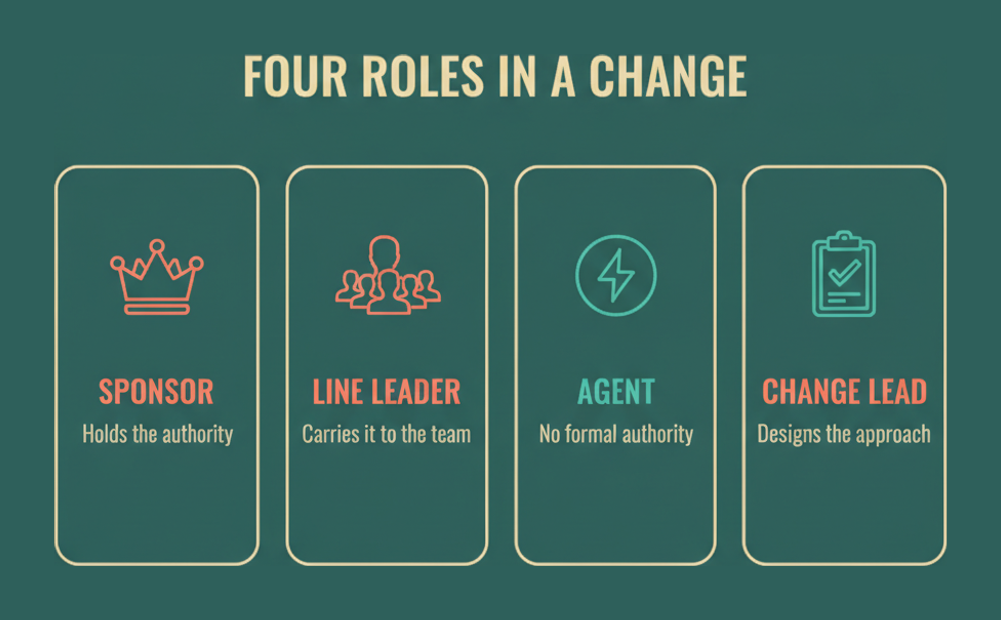
This is the area that disappeared from the retired four-topic syllabus, which makes it the single most likely gap in anyone revising from older material. Expect questions that describe a situation and ask which role should be acting.
The distinctions worth drilling
- A sponsor holds the authority and the accountability, and cannot delegate either
- A line leader carries the change into a team’s daily work, and is often the person under most pressure
- A change agent influences without formal authority, which is what makes the role difficult
- A change manager designs and runs the approach, rather than owning the outcome
Foundation or Practitioner: Where Should You Start?
Foundation, in almost every case. APMG describes its purpose as confirming enough knowledge to work as an informal member of a team on an organisational change initiative, which is exactly where most people start. The Practitioner level assumes you will be shaping the approach rather than contributing to it.
The exams differ in scale as well as depth. Foundation is 50 questions in 40 minutes with a pass mark of 25. Practitioner is 80 questions in five groups of sixteen, one group per syllabus area, over two and a half hours, with a pass mark of 40. The grouped structure is another confirmation that the syllabus really is five areas.
| Level | Questions | Duration | Pass mark |
|---|---|---|---|
| Foundation | 50 | 40 minutes | 25 of 50 |
| Practitioner | 80, in five groups of 16 | 2.5 hours | 40 of 80 |
How Does This Relate to the Change Management Institute?
They are separate organisations with a working relationship. APMG awards the certification and links directly to the Change Management Institute from its own product page. The Institute is the profession’s independent membership body and runs its own accreditation at three levels, assessing demonstrated practice rather than examined knowledge.
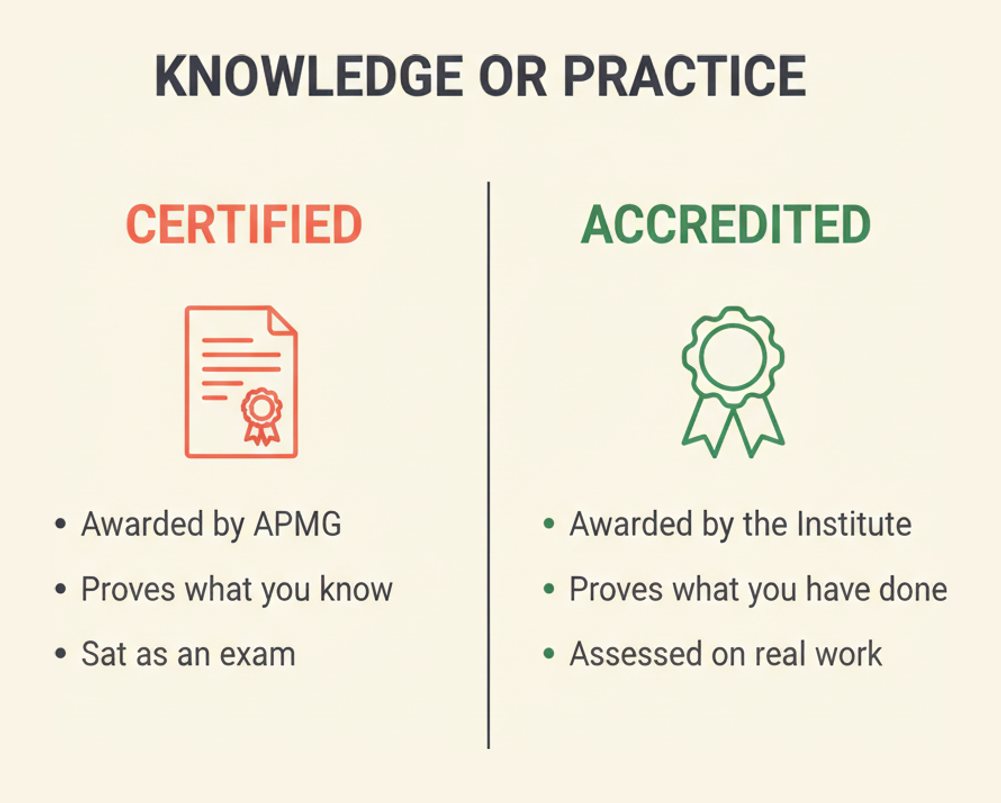
The two are complementary rather than competing. A certification proves you know the discipline; an accreditation proves you have practised it. Someone building a change management career typically starts with the former and pursues the latter once they have programmes behind them.
The Change Management Institute sets out what the profession expects of practitioners, and its three accreditation levels show what experience each stage requires.
Who Actually Needs This Credential?
HR business partners, organisational development specialists, learning and development leads, internal communications professionals, project and programme managers, and anyone who ends up owning the people side of a transformation without a title that says so. The syllabus is written for a team member rather than a specialist, which is why it travels well.
For HR professionals in particular, it fills a specific gap. HR certifications cover the function: employee relations, total rewards, talent acquisition, compliance. None of them covers how to move an organisation from one way of working to another, which is increasingly what HR is asked to do.
Where it complements an HR credential
The overlap is real but partial. Competency-based HR credentials such as the SHRM Certified Professional exam touch organisational effectiveness without going deep on change methodology, so the two sit alongside each other rather than substituting.
APMG’s Change Management product page lists the accredited training organisations and the self-study route, which is the practical starting point once you have decided the credential fits.
How Should You Prepare for a Closed Book Paper?
Study for recognition at speed. Forty-eight seconds a question with nothing to consult means the win comes from knowing every term cold rather than reasoning any of them out. Five areas with no weightings means even coverage, and the two areas most often under-prepared are change leadership and the organisational context.
- Start with the five area names and what each contains, so that every later fact has somewhere to attach itself rather than floating loose.
- Learn the four leadership roles next, because that area vanished from the older syllabus and is the most likely gap in second-hand study material.
- Work through the named models, including the Beckhard and Harris change formula, since APMG’s own sample paper shows models being asked about by name.
- Drill the pairs that sound alike: resistance against resilience, sponsor against change agent, engagement against communication.
- Read the organisational context area properly, including agile thinking and how change relates to project management, which the retired syllabus barely touched.
- Finish with two timed sample papers, because 48 seconds a question closed book is a pace you cannot judge from reading alone.
Foundational HR domain knowledge helps more than it looks, particularly around employee relations and engagement, and the HRCI PHR domain breakdown covers that adjacent ground if you are coming to change management from outside HR.
Frequently Asked Questions
How many questions are on the Change Management Foundation exam?
Fifty multiple choice questions in 40 minutes, which is 48 seconds each. The paper is closed book, so nothing may be consulted during it.
What is the pass mark for Change Management Foundation?
Twenty-five correct answers out of 50, which APMG publishes as a 50 percent pass mark. That is generous by certification standards, and the closed book is what makes it real.
How many topics are in the syllabus?
Five: organisational context and approach, people and change, change leadership and teams, stakeholder engagement and communication, and the work of the change manager. Older sources listing four are describing a superseded structure.
How much does the certification cost?
$406 USD for the exam. Training is separate and priced by the accredited organisation delivering it, with Foundation courses typically running three days.
Is the exam open book?
No. APMG states directly that the Foundation exam is closed book, so you answer entirely from what you have learnt rather than from reference material.
What is the difference between Foundation and Practitioner?
Foundation is 50 questions in 40 minutes with a pass mark of 25. Practitioner is 80 questions in five groups of sixteen over two and a half hours, with a pass mark of 40, and assumes you will shape a change approach rather than support one.
Do you need change management experience first?
No. APMG frames Foundation as confirming enough knowledge to work as an informal member of a team on an organisational change initiative, which makes it an entry point rather than a recognition of practice.
Is this the same as Change Management Institute accreditation?
No. APMG awards this certification for examined knowledge. The Change Management Institute is a separate professional body accrediting demonstrated practice at three levels. They complement each other.
Is training required to sit the exam?
No. You can self-study and buy the exam directly, or take an accredited course. Training organisations supply sample papers, which self-studying candidates need to source separately.
Is it useful for an HR professional?
Yes, because HR credentials cover the function rather than the transition. Change Management Foundation covers moving an organisation from one way of working to another, which is increasingly the work HR is handed.
Conclusion
Change Management Foundation is a people credential wearing a framework body’s badge. Five syllabus areas, four of them fundamentally about how people respond to being changed, examined in 50 closed book questions with a pass mark of 25. The most valuable thing to get right before you start is the syllabus itself, because the four-topic version still circulating omits change leadership entirely.
Learn the five areas as your scaffolding, drill the role distinctions and the named models, and give the organisational context area the attention older material never did. Then run two timed papers against the money site’s question set, because 48 seconds with nothing to look up is the one condition reading cannot rehearse.


