
Almost every HR credential assumes you already work in HR. The aPHR, formally the HRCI Associate Professional in Human Resources, is the one HRCI built for people who want an HR career but have not worked in the field yet. It is the only credential from the HR Certification Institute that asks for no prior HR experience, which makes it a practical first move for recent graduates, career changers, and managers who handle people without a formal HR title.
This guide walks through what the aPHR covers, how the exam is scored, what it costs, and the roles it can open. You will see the five functional areas that make up the syllabus, a realistic preparation plan, and honest guidance on whether an entry-level HR certification is the right investment for where you are now.
Table of Contents
- What Is the aPHR Certification and Who Is It For?
- What Does the aPHR Exam Format Look Like?
- What Are the aPHR Functional Areas?
- How Much Does the aPHR Exam Cost and How Do You Register?
- Is the aPHR Worth It for Entry-Level HR Professionals?
- How Does the aPHR Compare to the PHR and SHRM-CP?
- How Should You Prepare for the aPHR Exam?
- What Career Paths Open Up After Earning the aPHR?
- Frequently Asked Questions
- Conclusion
What Is the aPHR Certification and Who Is It For?
The aPHR is a knowledge-based credential from HRCI that certifies foundational understanding of United States human resources practices. It requires no HR work history, only a high school diploma or global equivalent. That design makes it ideal for people entering HR, non-HR managers who supervise staff, and professionals switching careers who need proof of core competence before landing their first HR role.
Unlike the PHR or SPHR, the aPHR does not measure years on the job. It measures whether you understand how HR functions operate across hiring, development, pay, employee relations, and legal compliance. HRCI describes the credential clearly: That is precisely what changes at the senior level, where the senior HR credential requirements put verified years of strategic work ahead of knowledge alone.
“Designed for those starting a career in HR or managing people without formal HR training, the aPHR builds foundational knowledge you can apply right away.”
The credential sits within a wider ladder of professional HR qualifications. You can learn how it relates to the broader HRCI credential family before committing. For most candidates, the aPHR is the sensible first rung: it validates knowledge early and signals genuine intent to build an HR career.
Who Benefits Most From the aPHR?
- Recent graduates targeting their first HR coordinator or assistant role
- Career changers moving into human resources from another field
- Team leads and supervisors who manage people without HR training
- Administrative professionals expanding into HR responsibilities
- Small-business owners handling hiring, payroll, and compliance themselves
What Does the aPHR Exam Format Look Like?
The aPHR exam contains 90 multiple choice questions and runs for 105 minutes, with an additional 30 minutes of administration time at the testing center. HRCI does not publish a percentage pass mark. It scales every exam to a common 100 to 700 range and sets the passing score at 500, so the result comes back as pass or did not pass rather than as a score you can convert into questions answered. Pearson VUE delivers the exam, either at a physical test center or through remote online proctoring, so candidates can choose the setting that suits them.
Knowing the structure early removes a lot of exam-day anxiety. The table below summarizes every specification you need to plan your attempt.
| Exam Specification | Detail |
|---|---|
| Exam Name | HRCI Associate Professional in Human Resources |
| Exam Code | aPHR |
| Number of Questions | 90 |
| Question Format | Multiple Choice Questions |
| Exam Duration | 105 Minutes plus 30 minutes administration time |
| Passing Score | Scaled score of 500 on a 100 to 700 range |
| Exam Fee | USD $300 |
| Application Fee | USD $100 |
| Registration Provider | Pearson VUE |
All questions are objective, so there is no essay or scenario writing. That format rewards steady recall of HR concepts and terminology rather than long-form analysis, which works in favor of candidates who prepare with focused practice.
What Are the aPHR Functional Areas?
The aPHR syllabus is divided into five functional areas, each carrying a fixed weight toward your final score. Compliance and Risk Management holds the largest share at 25%, closely followed by Employee Relations at 24%. Talent Acquisition, Compensation and Benefits, and Learning and Development make up the rest, so your study time should mirror these weightings to maximize your result.
The table lists the official functional areas and their exact weightings, exactly as HRCI structures the exam.
| Functional Area | Weight |
|---|---|
| Talent Acquisition | 19% |
| Learning & Development | 15% |
| Compensation & Benefits | 17% |
| Employee Relations | 24% |
| Compliance & Risk Management | 25% |
Because the two compliance and relations areas together account for nearly half the exam, they deserve early and repeated attention. Working through targeted aPHR practice questions for each area helps you spot weak topics well before test day.
What Each Area Covers
- Talent Acquisition: recruiting sources, job postings, interviewing basics, onboarding, and employer branding.
- Learning & Development: training delivery, orientation, career development, and measuring learning outcomes.
- Compensation & Benefits: pay structures, benefits administration, payroll concepts, and reward practices.
- Employee Relations: engagement, performance conversations, workplace behavior, and conflict handling.
- Compliance & Risk Management: employment law basics, workplace safety, record keeping, and risk controls.
How Much Does the aPHR Exam Cost and How Do You Register?
The aPHR carries an exam fee of USD $300 plus a USD $100 application fee, so budget for the full amount before you apply. Registration runs through HRCI first, where you submit an application confirming you meet the high school diploma requirement. Once HRCI approves you, you schedule the exam with Pearson VUE at a testing center or through remote proctoring.
Registration Steps in Order
- Create an account on the HRCI website and start an aPHR application.
- Confirm eligibility with your high school diploma or global equivalent.
- Pay the application and exam fees to receive your authorization to test.
- Book a date and location through Pearson VUE testing centers or online proctoring.
- Review your confirmation and testing rules before the appointment.
Plan your date with enough lead time to study each functional area properly. Many first-time candidates give themselves eight to twelve weeks between registration and exam day, which keeps preparation steady without long gaps that erode recall.
Is the aPHR Worth It for Entry-Level HR Professionals?
For someone with little or no HR experience, the aPHR is often worth it because it solves a real hiring problem: proving competence before you have a track record. It gives resumes a recognized credential, signals commitment to the field, and helps applicants clear early screening for coordinator and assistant roles where employers see many similar candidates.
The value depends on your situation. If you already hold an HR role with several years of experience, the PHR may serve you better. But if you are breaking in, the aPHR is a credible differentiator that costs far less time than a degree. You can confirm current requirements on the official aPHR credential page before deciding.
Weighing the Decision
- Strong fit: you have no HR title yet and want proof of foundational knowledge.
- Strong fit: you manage people and want to formalize your HR understanding.
- Reconsider: you already have years of HR experience and eligibility for the PHR.
- Reconsider: your employer specifically requires SHRM-CP instead.
Following a structured aPHR certification journey makes the investment pay off faster, because organized study turns the credential into demonstrated knowledge rather than a line on a resume.
How Does the aPHR Compare to the PHR and SHRM-CP?
The aPHR differs from the PHR and SHRM-CP mainly in experience level. The aPHR is HRCI’s knowledge-based entry credential and needs no HR experience, while the PHR is HRCI’s practitioner credential that requires work history. SHRM-CP comes from SHRM, a separate body, and targets professionals already performing HR duties. Choosing correctly depends on where you stand today.
The comparison below shows how the three credentials line up so you can pick the one that matches your experience and goals.
| Credential | Best For | Experience Required | Provider |
|---|---|---|---|
| aPHR | Beginners and career changers entering HR | None; high school diploma only | HRCI |
| PHR | Practitioners with operational HR duties | Yes; work experience required | HRCI |
| SHRM-CP | Professionals already performing HR work | Recommended HR role experience | SHRM |
If you are just starting out, the aPHR is the natural choice, since it is the only one of the three that opens without prior HR work. Once you gain experience on the job, you can step up to the PHR or move toward the SHRM-CP, depending on which framework your employers recognize.
How Should You Prepare for the aPHR Exam?
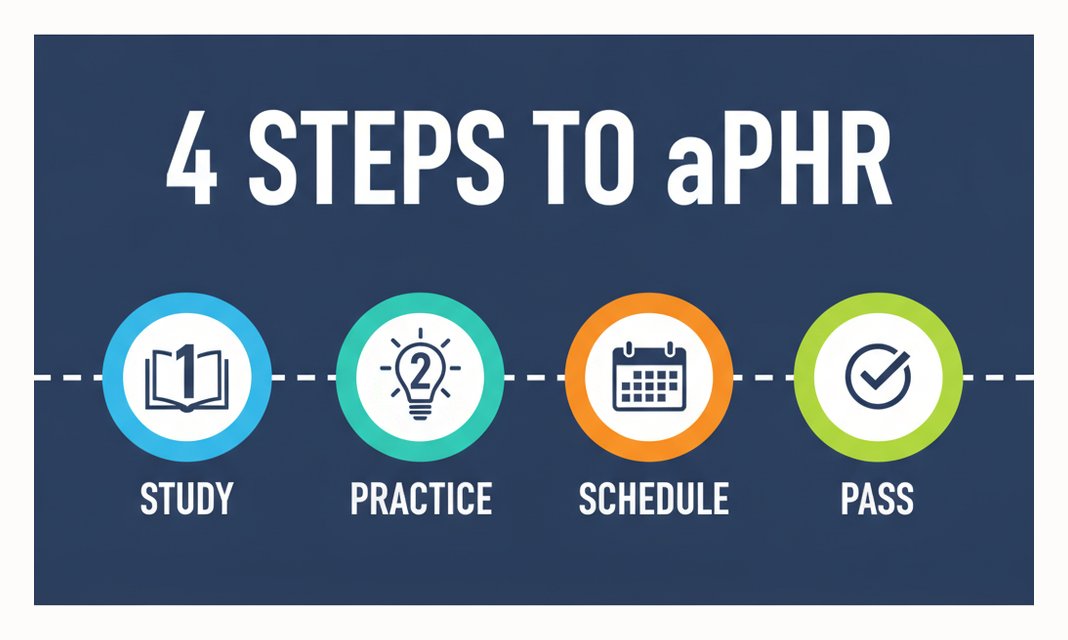
Effective aPHR preparation starts with the functional area weightings and works outward from there. Give the most study hours to Compliance and Risk Management and Employee Relations, since they carry the highest combined weight, then rotate through the remaining three areas. Consistent short sessions with regular self-testing beat occasional long cram sessions for a knowledge-based exam like this one.
A Practical Study Plan
- Map each functional area to its weight and schedule study time proportionally.
- Read one area at a time, taking notes on terminology and legal basics.
- Test yourself after each area with practice sets to confirm retention.
- Track weak topics and revisit them in a second pass.
- Sit a full-length timed mock exam a week before your date.
Study materials matter as much as method. A detailed complete aPHR preparation guide can anchor your reading, while regular practice questions keep your recall sharp under time pressure. Because HRCI publishes no percentage threshold, use mock tests to find weak functional areas rather than to chase a number, and aim for consistent accuracy across all five before booking.
Common Preparation Mistakes
- Spreading time evenly instead of following the functional area weights.
- Reading passively without testing recall along the way.
- Skipping the compliance area because it feels dry or technical.
- Booking the exam before mock scores are reliably above passing.
What Career Paths Open Up After Earning the aPHR?
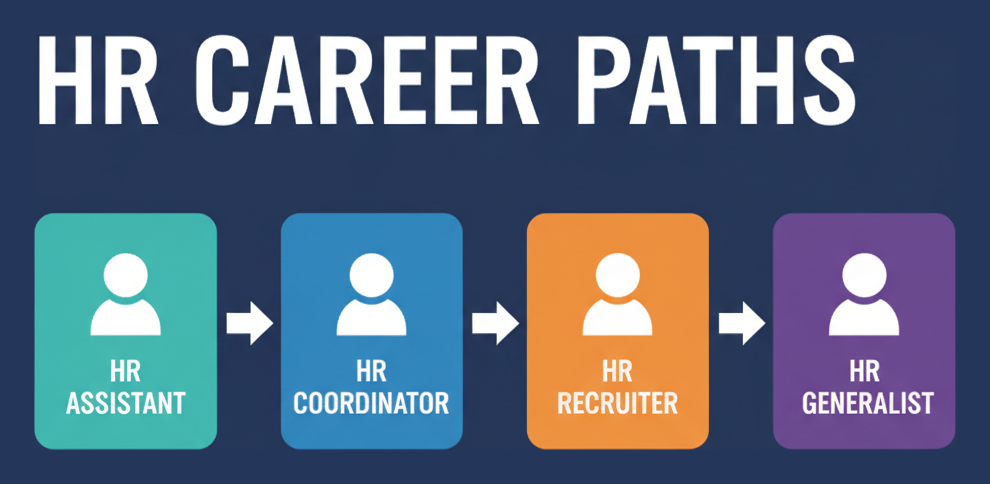
The aPHR positions you for entry-level HR roles where employers value foundational knowledge and clear intent to grow. Common first destinations include HR assistant, HR coordinator, recruiting coordinator, and HR administrator. From there, gaining experience opens the door to HR generalist roles and, over time, eligibility for advanced credentials such as the PHR and SPHR.
Human resources continues to offer steady demand across industries, and public occupation data confirms the field’s breadth of roles. You can explore standardized HR occupation data to see the tasks and skills tied to these positions.
Typical Progression
| Stage | Representative Roles |
|---|---|
| Entry | HR Assistant, HR Coordinator, Recruiting Coordinator |
| Developing | HR Generalist, Benefits Administrator, Talent Coordinator |
| Advancing | HR Specialist, HR Business Partner, HR Manager |
The aPHR does not guarantee a role, but it strengthens applications at the entry stage and gives you a knowledge base to build on. Paired with practical experience, it becomes a foundation for the higher credentials that define a long HR career.
Frequently Asked Questions
What is the aPHR certification?
The aPHR is HRCI’s Associate Professional in Human Resources credential. It certifies foundational knowledge of United States HR practices across five functional areas and is designed for people entering the field, so it requires no prior HR work experience.
How many questions are on the aPHR exam?
The aPHR exam has 90 multiple choice questions. You are given 105 minutes to complete them, plus 30 minutes of administration time at the testing center, and HRCI reports the result as pass or did not pass against a scaled score of 500, on a range running from 100 to 700.
Do you need experience to take the aPHR?
No HR work experience is required. You only need a high school diploma or global equivalent to apply, which is why the aPHR suits recent graduates, career changers, and managers moving into human resources responsibilities.
How much does the aPHR exam cost?
The aPHR exam fee is USD $300, plus a USD $100 application fee paid to HRCI. Budget for the full combined amount, and factor in any study materials or practice tests you plan to use during preparation.
What is the passing score for the aPHR?
HRCI sets the pass mark at a scaled score of 500 on a 100 to 700 range and publishes no percentage equivalent. Because scores are scaled, aim comfortably above that mark on practice tests before booking to give yourself a safe margin on exam day.
Which functional area carries the most weight?
Compliance and Risk Management carries the highest weight at 25%, followed by Employee Relations at 24%. Together these two areas account for nearly half the exam, so they deserve the most preparation time in any effective study plan.
How long does it take to prepare for the aPHR?
Most candidates prepare over eight to twelve weeks with consistent weekly study. The right length depends on your background, but steady sessions with regular self-testing work better than short, intense cramming for this knowledge-based exam.
Where is the aPHR exam delivered?
Pearson VUE delivers the aPHR exam. You can sit it at a physical testing center or through remote online proctoring, so you can choose the option that best fits your location and comfort with monitored online testing.
Is the aPHR better than the SHRM-CP?
They serve different audiences. The aPHR is entry-level and needs no experience, while SHRM-CP targets practitioners with HR responsibilities. Choose based on your experience level and any specific credential your target employers request in job postings.
Does the aPHR expire?
The aPHR is valid for three years and requires recertification through continuing education credits or retaking the exam. Planning recertification activities early keeps the credential active without a last-minute scramble near the renewal deadline.
Conclusion
The aPHR gives newcomers a credible, experience-free entry into human resources. With 90 questions, a scaled pass mark of 500, and five weighted functional areas, it rewards focused study that mirrors the exam blueprint. For graduates, career changers, and people managers, it turns foundational HR knowledge into a recognized credential that strengthens early job applications and sets up future growth toward the PHR and beyond. The smartest next step is to align your preparation with the functional area weights and test your recall often. Start by reviewing realistic practice questions for each area, build a steady study schedule, and book your exam once your mock scores clear the passing line with room to spare.


