
Human Resource Planning (HRP) is the process of ensuring that the right number of qualified people are available at the right time and place to fulfill organizational goals. It aligns the company’s workforce with its strategic objectives, ensuring that every position is filled by the most suitable candidate.
Before beginning the process, it’s essential to establish clear organizational objectives – what the company aims to achieve in areas such as production, marketing, finance, and expansion. These goals provide the foundation for all HR planning activities.
The six key steps in human resource planning are outlined below.
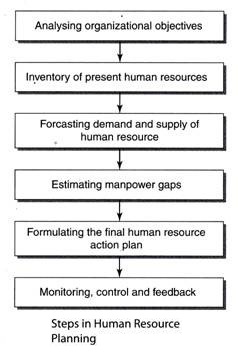
1. Analysing Organizational Objectives:
The first step involves identifying the future goals and targets of the organization. Objectives in areas like production, marketing, sales, and expansion determine the amount and type of work to be done.
By clearly defining these goals, HR managers can assess the kind of human resources required to meet them effectively.
2. Inventory of Present Human Resources:
Once objectives are clear, the next step is to evaluate the current workforce. Using an updated Human Resource Information System (HRIS), HR professionals can analyze the number of employees, their skills, performance levels, and growth potential.
This helps in identifying whether internal candidates (existing employees) can fill future vacancies or if new hires must be sourced externally through recruitment agencies or job portals.
3. Forecasting Demand and Supply of Human Resource:
At this stage, HR managers estimate both the demand (need) and supply (availability) of human resources for each position.
- Demand forecasting determines how many employees are needed and the types of skills required.
- Supply forecasting assesses the availability of talent — both internally and externally.
Matching job descriptions and job specifications with employee profiles ensures that the right person is selected for the right job.
4. Estimating Manpower Gaps:
After comparing the estimated demand and supply, organizations can identify manpower gaps — whether there’s a surplus or shortage of employees.
- A deficit means additional recruitment or training is required.
- A surplus may lead to reassignments, transfers, or even downsizing.
Training and development programs can also help bridge skill gaps, ensuring the workforce remains efficient and future-ready.
5. Formulating the Human Resource Action Plan:
Based on the analysis, HR professionals develop a strategic action plan to address manpower needs.
- In case of a deficit, actions include recruitment, training, promotions, or interdepartmental transfers.
- In case of a surplus, actions may involve redeployment, voluntary retirement schemes (VRS), or outplacement support.
The goal is to maintain an optimal workforce that supports organizational performance without overstaffing or understaffing.
6. Monitoring, Control and Feedback:
The final step involves implementing and monitoring the HR plan. Human resources are allocated as per requirements, and data is regularly updated to track progress.
Through control and feedback mechanisms, HR managers compare planned objectives with actual results to identify deviations and make necessary adjustments.
Continuous monitoring ensures that the organization always has the right talent to meet changing business needs.
Conclusion
Effective human resource planning is vital for organizational success. By systematically analyzing goals, assessing current resources, forecasting future needs, and continuously monitoring results, businesses can build a skilled, stable, and motivated workforce.
A well-executed HRP process not only prevents staffing shortages or surpluses but also ensures that the organization remains agile, competitive, and ready to meet future challenges.


