If you’re wondering whether investing in the SHRM certification is worth it, you’re not alone.
Unlike professions such as law, medicine, or teaching, human resources professionals are not legally required to hold a certification to practice. However, a quick look at job boards reveals that many employers prefer or even require SHRM-certified candidates when hiring for HR positions.
Since earning this credential demands both time and financial commitment, it’s important to understand what the SHRM certification is, what it involves, and how it can benefit your career before making the leap.
What is the SHRM Certification?
The SHRM Certification is a globally recognized credential offered by the Society for Human Resource Management (SHRM), the world’s largest professional association for HR practitioners.
The exam itself lasts about four hours and features two main types of multiple-choice questions:
- Knowledge-based questions, which test your understanding of HR concepts.
- Scenario-based questions, which evaluate how you apply that knowledge in real workplace situations.
This certification is accredited by the Buros Center for Testing, ensuring it meets the highest standards for professional assessment.
Recognized worldwide, the SHRM certification helps HR professionals demonstrate their expertise, credibility, and commitment to continuous learning. It’s a mark of distinction that can enhance your competitiveness in the job market and strengthen your case for promotion or leadership roles.
SHRM-CP vs. SHRM-SCP: What’s the Difference?
SHRM offers two certification levels, each tailored to different stages of an HR career:
- SHRM-Certified Professional (SHRM-CP)
This credential is designed for HR professionals working primarily in operational roles.
Typical responsibilities include:
- Implementing policies and procedures
- Managing employee relations
- Handling daily HR administration and compliance
If you’re involved in the hands-on, day-to-day aspects of HR, the SHRM-CP is likely the right starting point for you.
- SHRM-Senior Certified Professional (SHRM-SCP)
The SHRM-SCP is intended for senior-level HR professionals who focus on strategic leadership and organizational alignment.
This includes responsibilities such as:
- Developing HR strategies that align with company goals
- Overseeing teams that manage HR operations
- Designing policies based on performance analytics and workforce data
Even if you currently hold a senior position, you may choose to pursue the SHRM-CP first, especially if you’re not yet eligible or want to build a strong foundation—before attempting the more advanced SHRM-SCP.
SHRM Certification Eligibility Criteria
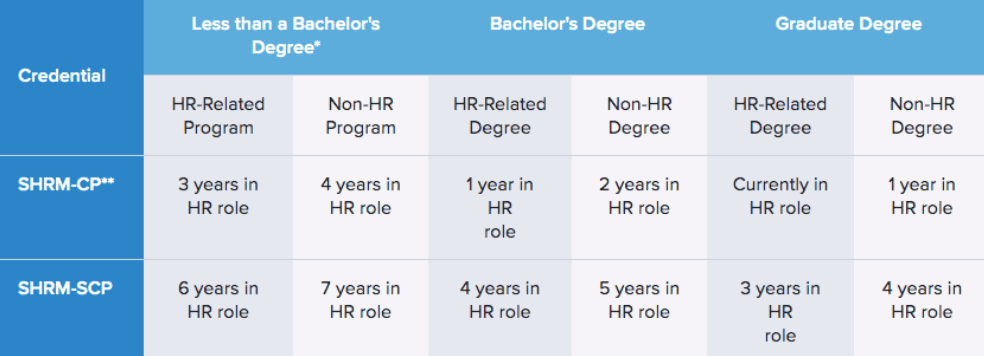
Eligibility for both exams depends on a combination of education and work experience in the HR field.
Here’s a general guideline:
- Bachelor’s degree in HR → at least 1 year of HR experience for the SHRM-CP
- Bachelor’s degree in HR → at least 4 years of HR experience for the SHRM-SCP
Applicants must meet these criteria at the time of application to qualify for their chosen exam level.
You can check your eligibility for both exams below:
It’s also important to note the exam difficulty:
- SHRM-CP pass rate: around 70%
- SHRM-SCP pass rate: around 50%
These statistics show that even seasoned HR professionals find the SHRM-SCP challenging. If your experience is still developing, starting with the SHRM-CP may be a more strategic move.
Why Pursue SHRM Certification?
The SHRM certification is more than just a credential it’s a career accelerator. It signals to employers that you have a strong command of HR knowledge, practical problem-solving abilities, and a dedication to professional growth.
Whether you’re aiming to stand out in a competitive job market, qualify for a leadership role, or simply validate your HR expertise, the SHRM certification can give your career the credibility and momentum it needs.


